On this page (15)
- The aircraft decides this, not the airline name
- The seat, compared properly
- What the head-to-head tests actually show
- Where you can actually fly from
- The fare brand can remove what you are paying for
- The lounges at each end
- Doha or Dubai as a connection
- Food and service on board
- Baggage, and what the fare brand changes
- Where the price difference actually comes from
- Two worked examples
- Which should you book?
- What we check before quoting either airline
- What we will not tell you
- Verify before you book
Quick answer
Qsuite wins on privacy and couple travel; Emirates wins on atmosphere and UK regional departures. But the aircraft decides this, not the airline name — Qsuite is not fitted to every Qatar flight.
Quick answer: Qatar's Qsuite is the better seat for sleeping and for travelling as a couple, because it has a properly closing door and can be converted into a double bed. Emirates wins on atmosphere, on the A380 experience and — for many UK travellers — on simply departing from an airport near where you live. But the single most important thing to check is not the airline at all: it is which aircraft your specific flight uses, because Qsuite is not fitted to every Qatar aircraft and Emirates business class differs sharply between the A380 and the 777.
The aircraft decides this, not the airline name
If you take one thing from this comparison, take this. “Qatar business class” and “Emirates business class” are not single products. Each airline flies several different business class cabins, and the gap between the best and worst cabin within one airline is wider than the gap between the two airlines.
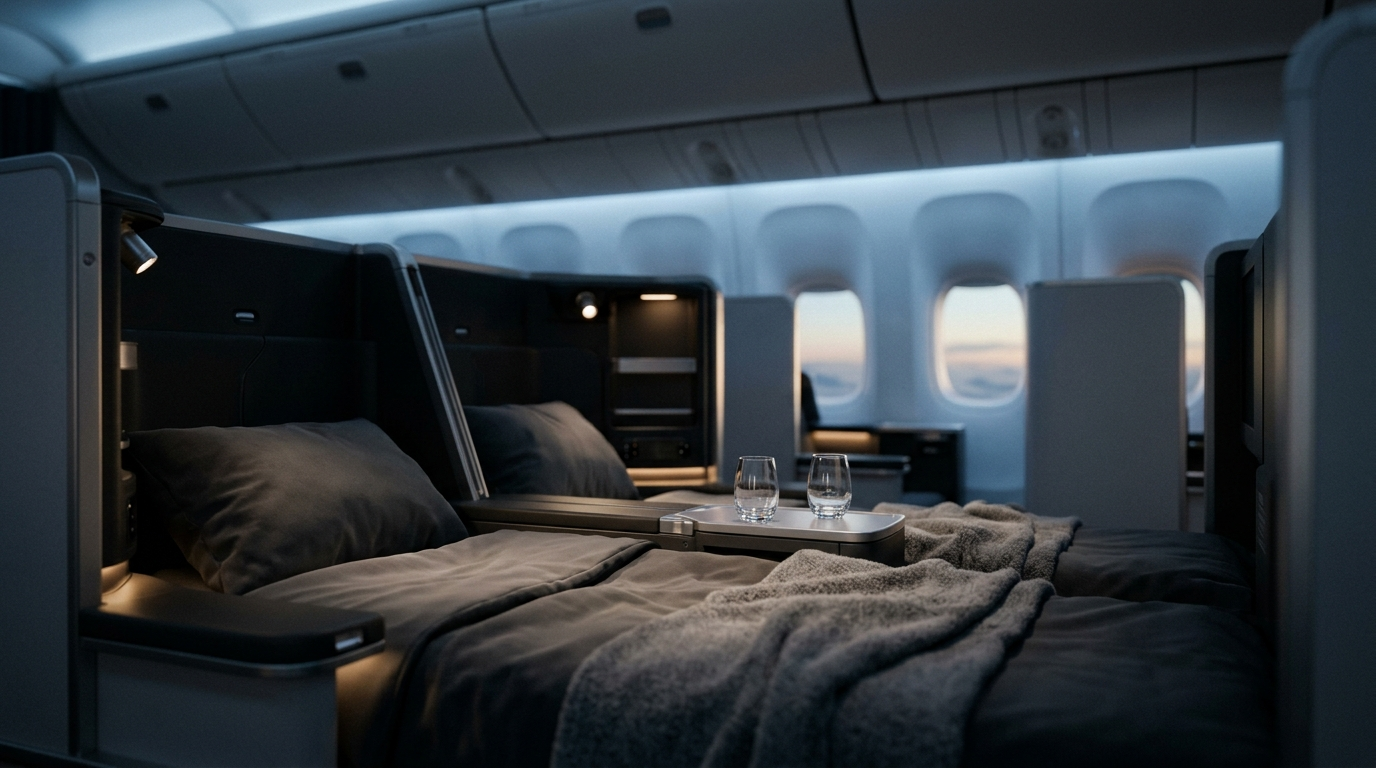
Qsuite — the cabin with the closing door that Qatar's advertising is built around — is fitted to the Airbus A350-1000, and to selected Boeing 777s and A350-900s. It is not on the A380. If you book Qatar assuming a Qsuite and your flight is operated by an aircraft without it, you will get a perfectly good business class seat that is not the product you thought you were buying.
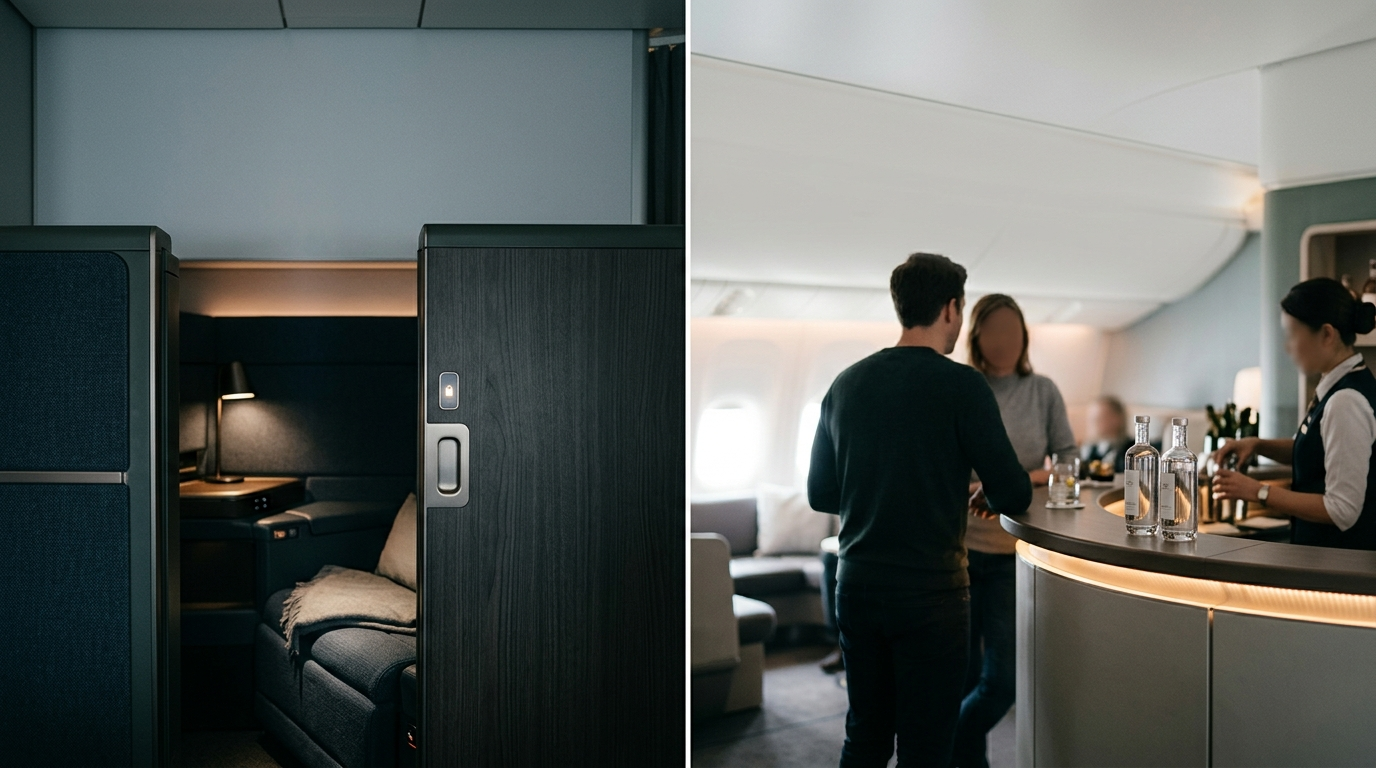
Emirates is the same story in a different shape. The A380 business class cabin is a 1-2-1 layout with a comfortable seat but no closing door, and it comes with the onboard bar that is genuinely part of the appeal. The Boeing 777 fleet is mixed: older retrofits added high dividing walls between seats without full doors, while the updated 777 business class introduced in March 2025 does have closing-door suites — but the door has a small gap at the ceiling rather than sealing completely as Qsuite's does.
So the honest first step is not choosing an airline. It is opening your specific flight and finding out which aircraft operates it, on the date you want to fly. Everything below only matters once you have done that.
The seat, compared properly
Privacy
Qsuite wins, and not marginally. The door closes and seals at the top, which means you are in an enclosed space rather than a well-screened one. On the updated Emirates 777 suites the door leaves roughly a four-centimetre gap at the ceiling, so you get most of the visual privacy but noticeably less of the acoustic separation. On the A380, there is no door at all.
Whether that matters depends entirely on you. For a daytime flight where you intend to work and eat, high walls are plenty. For an overnight flight where you want to disappear, the sealed door is a meaningful difference and a lot of frequent travellers will pay for it.
Sleeping
Both airlines give you a lie-flat bed in business class, so the comparison is about the quality of the sleep rather than whether you can lie down. Qsuite's advantage is enclosure and the ability to keep cabin light and movement out. Emirates' A380 advantage is a quieter aircraft — the A380 is genuinely one of the quietest widebodies in the sky, and on a long overnight sector that is worth more than most people expect.
If sleep is the whole point of paying for business class, Qsuite on an A350-1000 is the strongest combination available on these two airlines. If you sleep well anyway and value a smooth, quiet ride, the A380 is not the compromise it looks like on a spec sheet.
Travelling as a couple
This is Qsuite's clearest win. The centre pair converts into a genuine double bed with the divider lowered, and on some configurations four seats can be arranged into a shared quad space. For a couple starting a holiday, or a family travelling together, that is a different experience rather than a slightly better one.
Emirates' 1-2-1 layouts put couples next to each other with a divider, which is perfectly pleasant but is two seats side by side rather than a shared space.
Atmosphere
Emirates wins here and it is not close. The A380 onboard bar is a real social space at the back of the business cabin, and for a lot of travellers it is the single most memorable part of the flight. Qatar has nothing equivalent. If your idea of a good long-haul flight includes standing up, having a drink and talking to someone, that is a legitimate reason to choose Emirates and no seat specification overrides it.
What the head-to-head tests actually show
Independent comparisons through 2025 and 2026 have tended to land in the same place: Qatar takes the majority of individual scoring categories — a March 2026 head-to-head gave Qsuite seven of twelve against the refreshed Emirates 777 — while Emirates retains the categories that are hardest to quantify. Privacy, sleep quality and couple travel go to Qatar. Atmosphere, the bar and the sense of occasion go to Emirates.
We would treat that as a useful summary rather than a verdict, because it aggregates away the thing that decides most real bookings: your departure airport, your dates, and what the fare brand includes.
Where you can actually fly from
For UK travellers this is frequently the deciding factor, and it rarely appears in cabin comparisons at all.
Emirates has historically built a broad UK network reaching well beyond Heathrow, which means a traveller in Manchester, Birmingham, Glasgow or Newcastle can often start their trip at their own airport. Qatar also serves multiple UK cities, but the shape of the two networks is not identical and the frequencies differ.
The practical consequence is large. Starting from your local airport removes a domestic connection, a bag re-check and often three or four hours from the travel day. A slightly less private seat on a flight that leaves from your city usually beats a marginally better seat that requires you to get to Heathrow first. We would put the routing ahead of the cabin in almost every case where the two conflict.
The fare brand can remove what you are paying for
Both airlines sell more than one business class fare, and the cheapest one is not simply a discounted version of the expensive one — it is a different bundle of benefits attached to the same seat.
Qatar's Business Lite fare is the clearest example: it does not include lounge access at Al Mourjan in Doha. You can be sitting in a Qsuite and still be turned away from the lounge. Change and cancellation rules, baggage and seat selection also vary by fare brand on both carriers.
This is why we quote the fare brand alongside the price rather than beneath it. If the lounge, flexibility or baggage allowance is part of why you are buying business class, a cheaper fare that removes them is not a saving. Our guide to business class fare types covers how these bundles are constructed.
The lounges at each end
Both airlines give you a lounge at Heathrow and a lounge at their hub, and the hub is where the difference shows.
Doha's Al Mourjan – The Garden is the more highly regarded of the two hub lounges and was named World's Best Business Class Lounge at the 2025 Skytrax awards. It is calm, very large and open 24 hours, with private shower suites — which matters because so many UK itineraries connect through Doha in the small hours.
Emirates' Dubai lounge is bigger in raw capacity, boards directly, and has nap pods, a business suite and a children's playroom. It is less serene and more functional, but direct boarding on a tight connection is worth a great deal.
At Heathrow, Emirates uses Terminal 3 and Qatar uses Terminal 4. Neither Heathrow lounge is the reason to pick either airline. We have compared all of these in more detail in our guide to the best business class lounges for UK travellers.
Doha or Dubai as a connection
As transfer airports, both work well and both are large. Hamad International is generally the calmer experience and the walk between gates is usually shorter. Dubai International is busier and can involve longer transfers between concourses, but has more onward frequencies to more places.
The number to look at is not the airport's reputation but your own connection time, minus the realistic transfer. At either hub, thirty to forty minutes of a scheduled connection can disappear into walking, transfer security and boarding. A ninety-minute connection is not ninety minutes of usable time.
Food and service on board
Both airlines serve business class food on demand rather than to a fixed trolley schedule, which is the single most useful catering feature on a long flight. It means you can eat when it suits your sleep plan instead of when the crew reaches your row.
Qatar's dining leans towards restaurant-style plating and a menu you order from, and the service tends to be attentive without being intrusive. Emirates offers a broader, more theatrical proposition — a substantial wine list, and on the A380 the bar means you can eat and drink somewhere other than your seat, which genuinely changes how a fourteen-hour flight feels.
Service style is the most subjective part of any cabin comparison and the part where individual crews vary most. We would not choose between these two airlines on catering alone. Both are consistently strong, and a single poor flight on either is more likely to reflect one crew on one day than a systematic difference.
The practical catering question is simpler than the reviews suggest: if you want to sleep, eat in the lounge before departure and decline the main service on board. That advice applies equally to both airlines and will do more for your arrival condition than the choice between them.
Baggage, and what the fare brand changes
Business class baggage allowances on both carriers are generous compared with economy, but they are set by fare brand and route rather than by cabin alone, and the two airlines measure differently — some allowances are expressed as a number of pieces with a weight limit each, others as a single total weight.
That distinction matters if you are packing for a long trip or carrying equipment. A total-weight allowance is more flexible if you have one heavy bag; a piece-based allowance is better if you have two moderate ones. Neither is universally more generous, so check the figure attached to your actual fare rather than the headline for the cabin.
Cheaper business fares can also reduce what is included, in the same way they can remove lounge access. If you are travelling with more than hand luggage and a case, confirm the allowance before you book rather than at the airport, where excess charges are at their least forgiving.
Where the price difference actually comes from
Travellers often assume the more expensive of two business class fares is the better product. Frequently it is not — it is the same product on a different day, or with a different fare brand attached, or on a routing with a more convenient connection.
Four things move the price on these routes far more than the cabin does:
- Date. Business class inventory is released in limited buckets. Shifting a departure by a day or two can move the fare substantially, in either direction.
- Fare brand. The gap between a Lite fare and a standard fare is not a discount; it is a different bundle of lounge access, baggage and flexibility.
- Departure airport. A regional UK departure sometimes prices below Heathrow and sometimes well above it, depending on how the airline is filling that particular aircraft.
- Direction of demand. Both hubs are two-way markets, and a route can be expensive outbound and reasonable inbound in the same week.
This is why we treat a headline price on a comparison site as the start of the conversation rather than the answer. Two fares that look forty pounds apart can be a very different purchase once the brand and the routing are read properly.
Two worked examples
London to Bangkok, one traveller, overnight
Current private fares for this route are on our Business Class flights to Bangkok page.
Sleep is the whole point of this ticket. The recommendation is Qatar on a Qsuite-fitted aircraft at Business Classic or above — the sealed door and the Doha lounge both land exactly where they help, and the shower before the second sector materially changes how you arrive. On a Business Lite fare the same itinerary loses the lounge, and the case weakens considerably.
Manchester to Sydney, a couple, holiday
See current fares and UK departure points for Sydney.
Here the routing outweighs the cabin. Departing from Manchester rather than positioning to Heathrow removes a domestic sector, a bag handover and several hours from the first day. If Emirates builds that itinerary and Qatar does not on the dates required, Emirates is the better booking even though Qsuite would be the better seat. The exception is if the couple specifically want the double bed, in which case it is worth pricing both and deciding whether the extra travel day is a fair trade.
Which should you book?
Choose Qatar if: you are flying overnight and sleep is the priority; you are travelling as a couple and want the double bed; you value privacy highly; and you can get a Qsuite-fitted aircraft on your dates at a Business Classic fare or above.
Choose Emirates if: you are departing from a regional UK airport and it saves you a domestic connection; you want the A380 and the bar; you are travelling with children and the Dubai lounge facilities help; or the schedule simply fits your trip better.
Choose on price if: the two itineraries are genuinely close on routing, timing and fare brand. At that point the difference between these two airlines is smaller than the difference a good connection makes.
What we check before quoting either airline
- The aircraft type on every long-haul sector, and whether it carries the cabin you expect
- Whether a Qatar itinerary is genuinely Qsuite-fitted on your dates, not just on the route in general
- The fare brand, and whether lounge access, baggage and flexibility are included at that price
- Your realistic UK departure options, including regional airports
- Total journey time door to door, not flight time
- Connection length at the hub, minus transfer time
- What happens to the booking if the aircraft is swapped after ticketing
That last point matters more than people expect. Airlines substitute aircraft for operational reasons, and a swap can move you from a Qsuite to a different cabin on the same ticket. It is not common, but it is not rare either, and it is worth knowing your options before it happens rather than at the gate. Our guide on what to do when your aircraft changes sets out the practical steps.
What we will not tell you
We will not tell you that one of these airlines is universally better, because the evidence does not support it and your circumstances decide it. We will not promise a specific aircraft on a specific date, because schedules and equipment change. And we will not quote a lounge or a seat as included without checking the fare brand it is attached to.
What we will do is put the aircraft, the cabin, the fare brand and the connection in front of you alongside the price, so the comparison you make is the real one.
Verify before you book
Cabin rollouts, retrofits and fare rules change through the year. Before booking, confirm the current cabin on your specific aircraft and the inclusions on your specific fare using the airline's own site — Qatar Airways and Emirates both publish current seat and fare information. For UK passenger rights in the event of a cancellation or long delay, the Civil Aviation Authority is the correct reference.
Routes in this guide
Related Business Class routes
Current private UK fares for the destinations covered above. Quotes are dated to your itinerary — this is not a live checkout.
Keep reading
Related reading
References
Sources
Rules and fares change. These are the references behind the factual claims above — check them yourself before you travel.
Qatar Qsuite vs Emirates Business Class: Which Should UK Travellers Book? — FAQs
Prefer to talk? 786 262 0009 .
Is Qatar Qsuite better than Emirates business class?
For privacy, sleep and couple travel, yes. Qsuite has a door that seals fully and converts into a double bed. Emirates wins on atmosphere, particularly the A380 onboard bar, and frequently on UK regional departure options. Independent head-to-head tests in 2026 gave Qatar the majority of individual categories.
Is Qsuite available on every Qatar Airways flight?
No. Qsuite is fitted to the Airbus A350-1000 and to selected Boeing 777s and A350-900s. It is not fitted to the A380. Always check the aircraft operating your specific flight and date rather than assuming the route carries it.
Does Emirates business class have doors?
It depends on the aircraft. The A380 business class cabin has no door. Older Boeing 777 retrofits added high dividers without full doors. The updated 777 business class introduced in March 2025 does have closing-door suites, though the door leaves roughly a four-centimetre gap at the ceiling.
Which is better for couples, Qatar or Emirates?
Qatar. The centre pair of Qsuites converts into a genuine double bed with the divider lowered, and some configurations allow four seats to form a shared space. Emirates seats couples side by side with a divider, which is comfortable but is not a shared space.
Which airline is better for sleeping on a long-haul flight?
Qsuite on an A350-1000 is the strongest combination, because the sealed door keeps cabin light and movement out. The Emirates A380 is a genuinely quiet aircraft, however, so if you sleep easily the A380 is less of a compromise than a specification sheet suggests.
Can I fly Qatar or Emirates business class from a regional UK airport?
Both serve multiple UK cities, and Emirates has historically built a broad UK network well beyond Heathrow. Departing from your local airport removes a domestic connection and a bag re-check, which often matters more to the trip than the difference between the two cabins.
Does the cheapest Qatar business class fare include the lounge?
Not necessarily. Qatar's Business Lite fare does not include Al Mourjan lounge access in Doha, so you can travel in a Qsuite and still be refused entry to the lounge. Check the fare brand, not just the cabin name, before booking.
Is Doha or Dubai the better connection?
Hamad International in Doha is generally calmer with shorter walks between gates. Dubai is busier but offers more onward frequencies. What matters more is your own connection time minus realistic transfer time, since thirty to forty minutes can disappear into walking, transfer security and boarding at either hub.
What happens if the aircraft changes after I book?
Airlines substitute aircraft for operational reasons, and a swap can move you from a Qsuite to a different cabin on the same ticket. It is worth knowing your options before travelling rather than discovering the change at the gate, so ask what the airline's policy is when you book.
Should I choose the airline or the aircraft?
The aircraft. The gap between the best and worst business class cabin within a single airline is wider than the gap between these two airlines, so confirm the aircraft operating your specific flight before deciding which carrier to book.