On this page (15)
- Why the same seat has three prices
- What a fare brand actually controls
- What the three tiers typically include
- How to read the fare rules before you pay
- When a Lite fare is the right buy
- When the cheap fare is a false economy
- The change-fee arithmetic
- Mixed brands on one ticket
- Does the fare brand change the seat?
- Three worked examples
- What the brand names do not tell you
- Watch the connecting sectors
- Your rights are separate from your fare
- What we check before quoting a fare
- Verify before you book
Quick answer
Lite, Classic and Flex are fare brands, not cabins — the same seat with different things attached. Qatar's Business Lite, for example, carries no Al Mourjan lounge access at all.
Quick answer: Lite, Classic and Flex are fare brands, not cabins. All three put you in the same business class seat; what differs is what comes with it. The cheapest brand typically strips out lounge access, advance seat selection, generous baggage and any ability to change your ticket — Qatar's Business Lite, for example, does not include Al Mourjan lounge access in Doha. A Lite fare is a legitimate buy on a short, fixed trip, and a poor one on a long overnight itinerary where those benefits are the reason you upgraded.
Why the same seat has three prices
Airlines used to sell one business class fare with a set of rules attached. Now they sell the same seat in several bundles, in the same way a broadband provider sells one connection at three prices with different add-ons.
The commercial logic is straightforward. A corporate traveller whose plans might change will pay for flexibility. A couple who booked a holiday nine months out will not. Selling one fare to both means either losing the price-sensitive booking or under-charging the flexible one. Fare brands let the airline sell to both from the same cabin.
The consequence for you is that the cheapest business class price on a comparison site is often not comparable to the one next to it. Two fares forty pounds apart can differ by a checked bag, a lounge, a seat you chose, and several hundred pounds of change fees if your plans move.
What a fare brand actually controls
Names differ by airline — Lite, Basic, Saver, Value, Classic, Comfort, Flex, Flexible — but the levers are consistent.
Lounge access
The one that surprises people most, because it feels like a cabin benefit rather than a fare benefit. It is not. Qatar Airways' Business Lite fare does not include access to the Al Mourjan lounges in Doha. You can be seated in a Qsuite and refused entry to the lounge that made the routing attractive.
If you are connecting through a hub with a long layover, this is frequently the single most valuable thing the cheap fare removes. Our guide to business class lounges for UK travellers covers why that matters at each hub.
Advance seat selection
Cheaper brands may charge for seat selection or withhold it until check-in. On an overnight long-haul flight where the whole purchase is about sleeping, being auto-assigned a bulkhead seat behind a galley undoes the point of the ticket.
Baggage allowance
Business class allowances are generous, but they are set by fare and route, not by cabin alone. A Lite fare can carry a smaller allowance than you would expect for the cabin, and airport excess charges are unforgiving.
Changes and cancellations
The core difference. A Lite fare is typically non-changeable and non-refundable, or changeable only for a substantial fee plus any fare difference. Flex fares allow changes for little or nothing and often permit a refund.
Frequent flyer earning
Cheaper brands frequently earn fewer miles and, importantly, fewer tier-qualifying points. If you are working towards status, the cheap fare can cost you more than it saves.
Upgrade eligibility
Discounted brands are often ineligible for upgrades, whether paid or using miles. If your plan involves upgrading a sector later, check before you buy.
What the three tiers typically include
| Lite / Saver | Classic / Standard | Flex | |
|---|---|---|---|
| The seat | Same | Same | Same |
| Lounge access | Often excluded | Normally included | Included |
| Seat selection | Paid or at check-in | Usually free | Free |
| Baggage | Reduced | Standard | Standard or higher |
| Changes | Fee, or not permitted | Moderate fee | Free or low fee |
| Refund | Rarely | Sometimes, with a fee | Usually |
| Miles earned | Reduced | Standard | Enhanced |
Treat this as the shape of the market rather than a specification. Every airline draws the lines differently, and some move them between routes and seasons. The table tells you what to look for; the fare rules for your specific booking tell you what you are getting.
How to read the fare rules before you pay
The information is always there. It is rarely prominent.
- Find the brand name. It sits near the price, often in small text: “Business Lite”, “Business Saver”, “Business Classic”.
- Open the fare conditions panel. Usually a link labelled “fare rules”, “conditions” or a small information icon.
- Check the four that matter: lounge access, baggage, seat selection and change rules.
- Check every sector. A ticket can carry different brands on the outbound and return, and connecting sectors may be booked in a different class again.
- Screenshot it. If there is later a dispute about what you bought, the conditions at the time of purchase are what matter.
If a booking page will not show you the conditions clearly, that is itself information. On a four-figure purchase you are entitled to know what the rules are before you pay, not after.
When a Lite fare is the right buy
We are not against cheap fares. On the right trip they are straightforwardly good value.
- Fixed dates you are confident about. A wedding, a booked cruise, a holiday with paid accommodation. Flexibility you will never use is not worth paying for.
- Short or daytime flights. If you are not planning to sleep and the connection is brief, the lounge and seat-selection losses cost you little.
- Light packing. If you travel with hand luggage and one case, a reduced allowance may still be plenty.
- Nonstop itineraries. No hub connection means no long layover, which removes most of the lounge argument.
- When the saving is genuinely large. A few hundred pounds on a fixed-date trip is a real saving. Forty pounds is not worth the constraints.
When the cheap fare is a false economy
- Long hub connections. A five-hour layover without lounge access is five hours in a terminal seat, having paid business class prices.
- Overnight flights where sleep is the point. Losing seat selection can cost you the seat that justified the fare.
- Plans that might move. One change on a non-changeable ticket can cost more than the entire upgrade to Flex would have.
- Trips carrying equipment or extra luggage. Airport excess charges will erase the saving quickly.
- When you are chasing status. Reduced tier points can cost you a year of benefits.
The change-fee arithmetic
Most travellers assess flexibility emotionally — “we definitely won't change” — when it is a simple calculation.
Take the price gap between the Lite and the Flex fare. Then find the cost of changing the Lite fare: usually a fixed fee plus any difference in fare at the time of the change, and that second part is the one people forget. Business class fare differences close to departure can be large.
Now estimate honestly how likely a change is. If the gap between the brands is modest and the realistic chance of changing is meaningful, the flexible fare is usually the rational purchase. If your dates are locked and the gap is substantial, take the cheap fare and accept the constraint knowingly.
The mistake is not choosing the cheap fare. The mistake is choosing it without knowing what a change would cost.
Mixed brands on one ticket
A single booking can carry different fare brands on different sectors, and this catches out experienced travellers.
You may hold a Classic fare outbound and a Lite fare on the return, which means lounge access on the way there and none on the way back. On itineraries combining two airlines, the rules can differ by carrier as well as by sector — see our guide to mixing airlines on a business class trip.
When we quote, we set out what applies on each sector rather than describing the ticket as a single product, because in these cases it is not one.
Does the fare brand change the seat?
No, and this is worth stating plainly because the fare-brand system invites the assumption.
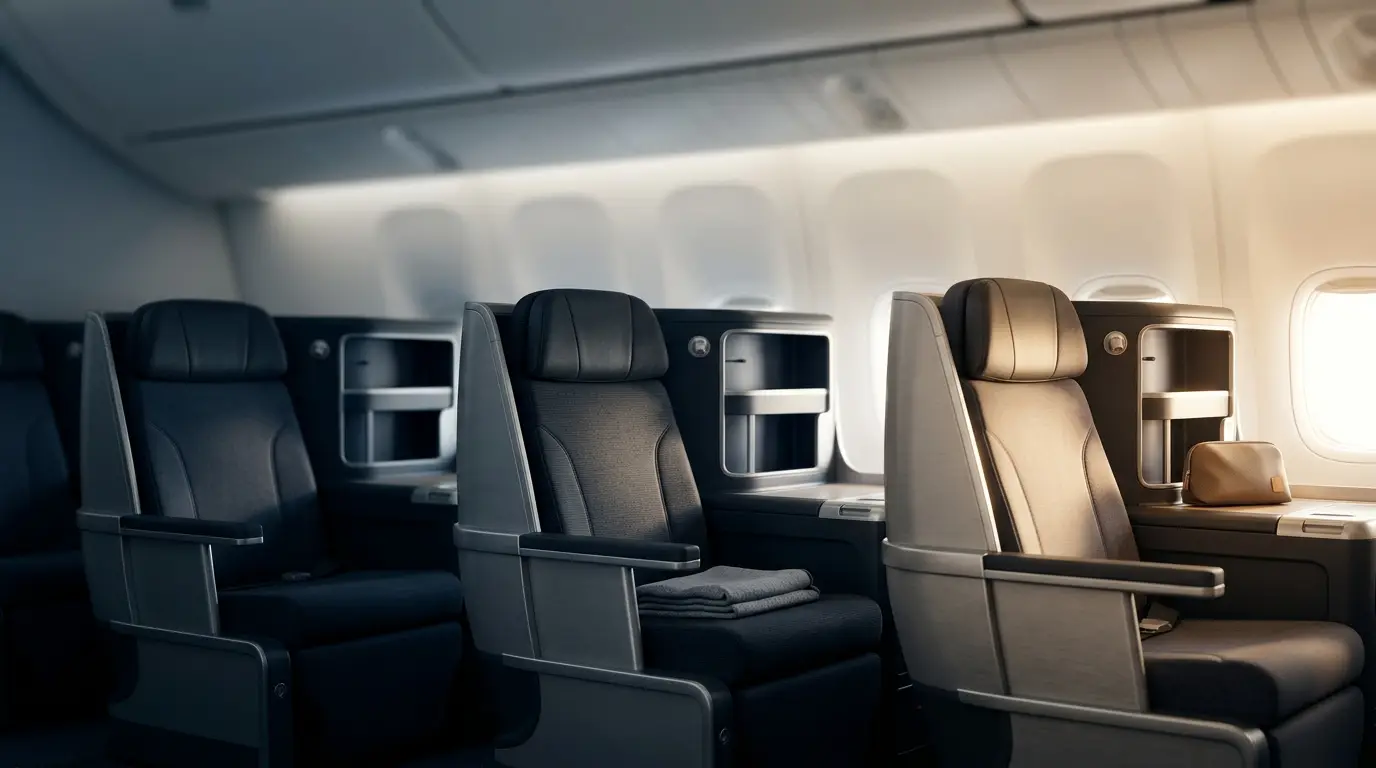
A Lite fare and a Flex fare on the same flight put you in the same cabin, in the same type of seat, with the same crew and the same catering. What varies is the ground experience and the contractual flexibility.
What does change the seat is the aircraft. That is a separate question and a more important one for the flight itself — we cover it in our guide to why the aircraft type matters more than the airline name.
Three worked examples
The arithmetic is easier to see against real trips.
A wedding in Delhi, dates fixed nine months out
The dates cannot move. The itinerary is a single connection, and the layover is short. Here the Lite fare is straightforwardly correct: you are not going to change, you will barely use a lounge, and the flexibility premium buys nothing. Take the saving.
A business trip to Singapore that might move by a week
Now the calculation inverts. If the trip slips, a non-changeable ticket has to be rebooked at whatever business class costs at short notice, which can be double. The Flex premium is effectively an insurance policy priced well below the risk. Buy the flexible fare and treat the difference as the cost of the uncertainty.
A honeymoon to the Maldives with a long Gulf connection
Current private fares for this trip are on our Business Class flights to the Maldives page.
The dates are fixed, so flexibility does not matter — but the itinerary has a six-hour hub connection and an overnight sector where the seat is the point of the purchase. Here the Lite fare removes exactly the two things this trip needs: lounge access for the layover, and seat selection so the couple can sit together. The middle brand is usually the right answer. This is the case where the cheapest and the most expensive fare are both wrong.
What the brand names do not tell you
Fare brand names are marketing, and they are not standardised across the industry. One airline's “Classic” is another's entry-level product; one carrier's “Lite” still includes a checked bag while another's does not.
This matters when comparing two airlines side by side. A Lite fare on Airline A and a Lite fare on Airline B are not equivalent purchases just because the word matches. The only reliable comparison is inclusion by inclusion: lounge, bag, seat, change fee, on each specific fare.
It also matters over time. Airlines revise fare families periodically, adding tiers or moving benefits between them. A guide written two years ago may describe a structure that no longer exists, which is part of why we point readers at the airline's current conditions page rather than reproducing a benefits table as though it were permanent.
Watch the connecting sectors
On a multi-sector itinerary the fare brand is not the only thing that varies — the booking class on a short connecting flight may not be business at all.
It is common for a long-haul business class ticket to include a short domestic or regional sector in economy, particularly where the operating partner does not sell a premium cabin on that route. That is a legitimate ticket construction and often the best way to reach a smaller city, but it should be visible to you before you pay, not discovered at check-in when your bag allowance changes.
Ask specifically: what cabin am I in on each sector, and what fare brand applies to each. A quote that answers only for the long-haul leg has not answered the question.
Your rights are separate from your fare
One important distinction. Fare rules govern changes you choose to make. They do not govern what happens when the airline cancels or heavily delays your flight.
For flights departing the UK, and for UK or EU carriers flying into the UK, the Civil Aviation Authority sets out entitlements to re-routing, care and in some cases compensation. Those apply regardless of whether you bought a Lite fare or a Flex one. A non-refundable ticket is not non-refundable when the airline is the one that cancelled.
What we check before quoting a fare
- The brand on every sector, outbound and return
- Whether lounge access is included at that price, at each hub used
- Baggage allowance as it applies to that fare, not the cabin generally
- Whether seats can be selected at booking or only at check-in
- The change fee and whether a fare difference would also apply
- Whether the fare is refundable, and on what terms
- Miles and tier points earned, where the client collects
- The gap to the next brand up, so the trade-off is visible rather than assumed
We will quote a Lite fare where it suits the trip. What we will not do is quote it as though it were the same product as the fare above it.
Verify before you book
Fare brands, inclusions and fees change, and airlines vary them by route and season. Confirm the conditions for your specific fare on the operating airline's own site before paying, and keep a copy. For UK passenger rights in the event of cancellation or long delay, the Civil Aviation Authority is the correct reference.
Routes in this guide
Related Business Class routes
Current private UK fares for the destinations covered above. Quotes are dated to your itinerary — this is not a live checkout.
Keep reading
Related reading
References
Sources
Rules and fares change. These are the references behind the factual claims above — check them yourself before you travel.
Business Class Fare Types Explained: Lite, Classic and Flex — FAQs
Prefer to talk? 786 262 0009 .
What is a Business Lite fare?
Business Lite is the cheapest business class fare brand. It puts you in the same seat and cabin as a more expensive fare, but typically removes lounge access, free advance seat selection, part of the baggage allowance and any ability to change the ticket without a substantial fee.
Does Business Lite include lounge access?
Often not. Qatar Airways Business Lite does not include access to the Al Mourjan lounges in Doha, so you can travel in a Qsuite and still be refused entry. Check the fare conditions for your specific booking rather than assuming lounge access comes with the cabin.
Is the seat different on a cheaper business class fare?
No. Lite, Classic and Flex fares on the same flight give you the same cabin, the same type of seat, the same crew and the same catering. What changes is the ground experience and the contractual flexibility. The aircraft determines the seat, not the fare brand.
When is a Lite fare worth buying?
On fixed dates you are confident about, on nonstop or short daytime flights, when you pack light, and when the saving is genuinely large. Flexibility you will never use is not worth paying for.
When is a cheap business class fare a false economy?
On long hub connections where losing lounge access means hours in a terminal seat, on overnight flights where losing seat selection can cost you the seat you needed, when your plans might change, when carrying extra luggage, and when you are working towards airline status.
How do I work out whether to pay for a flexible fare?
Compare the price gap between the brands against the real cost of changing the cheaper one - which is usually a fixed fee plus any fare difference at the time of the change. Business class fare differences close to departure can be large, and that second part is the one travellers forget.
Can one ticket have different fare brands?
Yes. You may hold a Classic fare outbound and a Lite fare on the return, giving lounge access one way and none the other. On itineraries combining two airlines the rules can differ by carrier as well as by sector, so check each one.
Do cheaper fares earn fewer frequent flyer miles?
Frequently, yes, and they often earn fewer tier-qualifying points as well. If you are working towards status, a discounted brand can cost you more in lost progress than it saves on the ticket.
Where do I find the fare conditions?
The brand name usually sits near the price in small text, with a fare rules or conditions link beside it. Check lounge access, baggage, seat selection and change rules on every sector, and keep a copy of what you were shown at the time of purchase.
Is a non-refundable ticket refundable if the airline cancels?
Fare rules govern changes you choose to make, not what happens when the airline cancels or heavily delays a flight. For flights departing the UK, and UK or EU carriers flying into the UK, Civil Aviation Authority entitlements to re-routing, care and sometimes compensation apply regardless of fare brand.