
Economy
From £845
return, per person
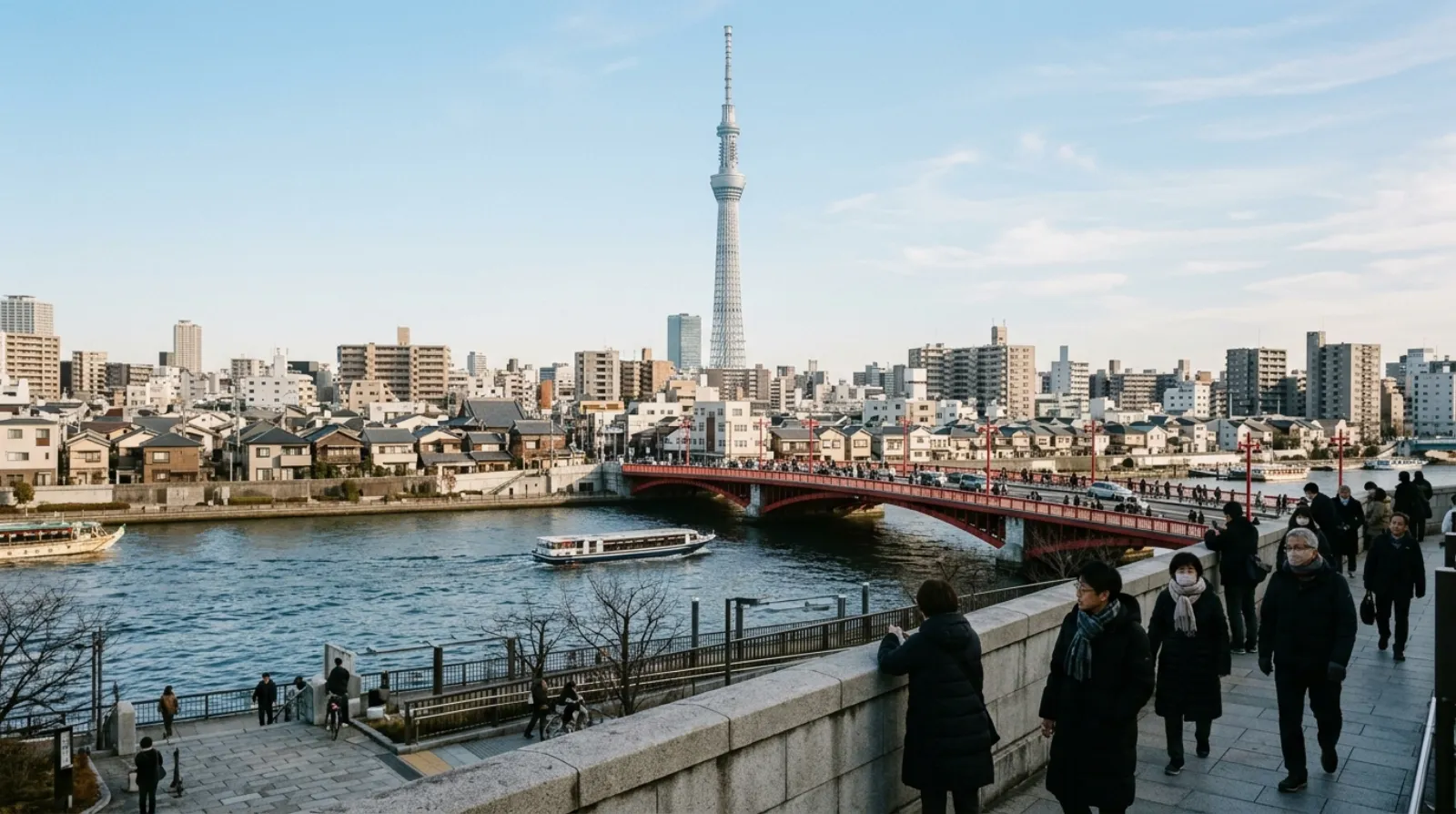
Asia & Far East · ATOL Protected
ATOL Protected
Business Class flights to Tokyo from the UK start from £2,511 return. All three UK nonstops fly London Heathrow to Haneda, not Narita — All Nippon Airways, British Airways and Japan Airlines — taking about 13 hours 55 minutes, the longest nonstop in our programme. No other British airport reaches Japan without a change, and Japan is eight or nine hours ahead. British citizens get a visa on arrival for up to 90 days.
Return fares per person from the UK. Your quote is confirmed against live availability for your dates.
Economy
From £845
return, per person
Premium Economy
From £1,503
return, per person
Business Class
From £2,511
return, per person
First Class
From £5,412
return, per person
Our fares. Prices shown for Tokyo are our own fares, based on recent bookings. Final business class fares depend on your dates, airline and availability. ATOL protected. Get a free exact quote or call 07862 620009.
| UK airport | Nonstop? | Airlines |
|---|---|---|
| London Heathrow | Yes, to Haneda | All Nippon Airways, British Airways Business Class, Japan Airlines |
| London Gatwick | No | No Japan nonstop |
| Manchester | No | No Japan nonstop |
| Birmingham | No | No Japan nonstop |
| Glasgow | No | No Japan nonstop |
| Edinburgh | No | No Japan nonstop |
| Newcastle | No | No Japan nonstop |
One UK airport, three airlines. That is an unusual shape — plenty of choice of carrier, none at all of departure point. It also means Tokyo is the only way into Japan without changing planes: Osaka, the other Japanese city we sell, has no UK nonstop whatsoever.
Note also that Virgin Atlantic does not serve either Tokyo airport, which surprises people who remember it flying to Japan.
Glasgow GLA → NRT
Business From £2,311
Manchester MAN → NRT
Business From £2,411
New Castle NCL → NRT
Business From £2,411
London All LON → NRT
Business From £2,511
Birmingham BHX → NRT
Business From £2,539
This is worth stating plainly, because it shapes any Japanese itinerary booked from Britain.
| Japanese city | UK nonstop? | Business Class from |
|---|---|---|
| Tokyo | Yes — Heathrow to Haneda, three airlines | £2,511 |
| Osaka | No UK nonstop at all | £2,368 |
If your trip takes in both — and a great many do, because the two cities are the standard Japanese pairing — the sensible shape is usually to fly into one and out of the other, using Japan's domestic network or the rail system in between rather than doubling back.
Ask us to price an open-jaw. On a country where internal travel is this good, it frequently beats a return and saves a long backtrack at the end of the trip.

London All (LON) ⇄ Tokyo(NRT)
LON → NRT

Manchester (MAN) ⇄ Tokyo(HND)
MAN → HND
Glasgow (GLA) ⇄ Tokyo(NRT)
GLA → NRT

Birmingham (BHX) ⇄ Tokyo(NRT)
BHX → NRT

New Castle (NCL) ⇄ Tokyo(HND)
NCL → HND
If you think a London flight to Tokyo lands at Narita, it does not. All three UK nonstops go to Haneda — the airport far closer to the centre of the city — and the difference is an hour or more of your life on each end of the trip. Business Class starts from £2,511 return.
At 13 hours 55 minutes this is the longest nonstop flight in our entire programme, and only London reaches Japan without a change of plane. The rest of the region sits under Business Class flights to Asia, and the wider programme under Business Class flights from the UK.
Tokyo has two major airports and the distinction matters more here than in almost any two-airport city we sell.
Haneda (HND) sits close to central Tokyo and carries every UK nonstop. All Nippon Airways, British Airways and Japan Airlines all fly London Heathrow to Haneda.
Narita (NRT) is much further out — a substantial journey from the city, not an airport transfer. Reading Narita's own route listing, there is no current UK airline service at all; its only London entry is a historical statistics table that still lists Alitalia, an airline that no longer exists.
So if a booking engine offers you a Tokyo itinerary arriving at Narita, it is a connecting journey through somewhere else, not a UK nonstop. That is not automatically wrong — but you should know you are choosing it, and you should factor in the longer journey at the far end.
At Haneda, international flights use Terminal 3, renamed from the International Terminal on 14 March 2020, which has its own rail station.
| UK departure | Business Class from | Nonstop? |
|---|---|---|
| Glasgow | £2,311 | No — connecting |
| Manchester | £2,411 | No — connecting |
| Newcastle | £2,411 | No — connecting |
| London | £2,511 | Yes — Heathrow to Haneda |
| Birmingham | £2,539 | No — connecting |
Per passenger, return. Excl. taxes and carrier charges. Subject to availability.
Read that column carefully, because it runs backwards. Glasgow is the cheapest departure and London is the dearest — and London is the only one with a nonstop. The cheaper regional fares are all connecting itineraries.
On a fourteen-hour flight that is a significant trade. A connection does not add three hours here; it adds a change of aircraft to a journey that already runs most of a day, usually with a long sector on either side. For most travellers the London nonstop is worth its premium, and we would say so rather than point you at the cheapest line.
Business Class to Tokyo starts from £2,511 return per passenger and subject to availability. Other cabins on the same route: Economy from £845, Premium Economy flights from the UK from £1,503, and First Class flights from the UK from £5,412.
The First Class step here is the widest of any route in Asia — well over twice the Business Class fare. That is worth knowing before you ask about it, because on several other Asian routes the gap is considerably narrower.
We checked what was genuinely on sale on 15 November 2026, departing London Heathrow. Real bookable itineraries on one day's availability, not a timetable.
| Option that day | Total time | What it is |
|---|---|---|
| Nonstop | 13h 55m | All Nippon Airways, an evening departure arriving next evening |
| From any other UK airport | Longer, with a change | Which is what the cheaper regional fares buy |
Thirteen hours fifty-five is the longest nonstop we have measured anywhere in the programme — longer than Singapore, longer than São Paulo, longer than any American or Australasian city we sell as a single sector. It is the defining fact about this trip and everything else follows from it.
The departure we found left in the evening and arrived the following evening, having crossed most of a day. You lose a day going out and get one back coming home, which is worth planning around rather than discovering.
Japan is eight or nine hours ahead of the UK depending on the time of year. Combined with a fourteen-hour flight, that makes Tokyo the most demanding journey we sell in terms of what it does to you.
There is effectively no overlap with a UK working day. A Tokyo morning is the middle of a British night; by the time London opens, Tokyo is finishing. If you must stay in contact with home, you will be doing it at unsociable hours in one direction or the other — there is no civilised compromise.
Most people find eastbound the harder direction, and on this route it is the outbound. You leave in the evening, fly through a compressed night and most of a day, and land in the evening again with your body convinced it is the small hours. Whether you slept properly on that sector is the single biggest factor in whether your first full day works.
Be realistic about short trips. A two-night visit to Tokyo means twenty-eight hours of flying and a nine-hour time change for barely more than a day on the ground, and you will spend most of it adjusting. Where the trip can be four or five days, make it so.
| Cabin | From | The honest case on a fourteen-hour flight |
|---|---|---|
| Economy | £845 | Fourteen hours plus a nine-hour change is genuinely punishing |
| Premium Economy | £1,503 | Better, but it reclines — and fourteen hours is a long time not to lie down |
| Business Class | £2,511 | The cabin this route is built for; sleep is the whole point |
| First Class | £5,412 | The widest step up to First anywhere in Asia |
Of everything we sell, this is the route where we would argue hardest for the flat bed. Fourteen hours into a nine-hour time change is the most demanding combination in the programme, and a reclining seat asks a great deal of you.
If cost is the constraint, split the cabins rather than downgrading both legs. Take Business Class outbound, where sleep decides your first days, and consider a lower cabin on the way home where you can recover in your own bed. Ask and we will price it that way.
Three airlines fly this route and none of them flies a single aircraft type. At fourteen hours the cabin is not a detail — it is most of what you are buying, and the differences between products are large.
The questions worth asking are short. Does every seat have direct access to the aisle, or do some passengers step over a neighbour? Does it lie genuinely flat, or at an angle? Is there a door? How wide is the bed at the shoulder rather than at the seat cushion — and at this length, how long is it?
We check which airline and aircraft is scheduled on your dates before you book, and we will tell you plainly where a cabin is not what you are picturing.
Layouts differ enormously between the three carriers and between aircraft within each. In a 1-2-1 staggered cabin the middle pair are sometimes side by side and sometimes separated by a console; in other layouts you may be angled away from each other for the whole flight. On a fourteen-hour overnight that is worth settling in advance — tell us and we will check the seat map.
Haneda's proximity to central Tokyo is the practical reason to care which airport you land at. International flights use Terminal 3, which has its own rail station, so the connection into the city is a train ride rather than an expedition.
Compare that with Narita, which is a substantial journey out of town — on a trip where you have already been travelling for fourteen hours and your body thinks it is the middle of the night, that difference is not a small one.
If you are connecting onward within Japan, remember that domestic flights and the rail network both work from central Tokyo rather than from the airport you land at, so tell us the onward plan and we will build the timing around it properly.
Only Heathrow has a nonstop, so for most of Britain there is a real decision — and on a fourteen-hour route it deserves more thought than it would on a short one.
Travelling to Heathrow and taking the nonstop means a train, a domestic flight or a night before, and the cost of that is real. What you get is one aircraft, one check-in, and a single sector you can sleep through. On the longest route we sell, that simplicity is worth a good deal.
A connecting itinerary from your own airport avoids the journey south, and the fares above show it can be cheaper. What it costs is a change of aircraft in the middle of an already enormous journey, usually through a Gulf or European hub, with the risk that the cabin differs between sectors.
Our honest reading is that London wins more often on this route than on almost any other, precisely because the flight is so long. A connection that would be a minor irritation on a six-hour Gulf sector becomes a substantial burden when the total journey runs past eighteen hours.
Check the cabin on every sector if you do connect. A journey sold as Business Class does not always mean Business Class on both legs, because the long-haul and regional aircraft can be configured quite differently. We confirm it before you book, every time.
Tell us your postcode and your dates and we will price both shapes with real numbers rather than a rule of thumb.
The UK business flow into Tokyo runs to finance and asset management, technology and electronics, automotive, pharmaceuticals and life sciences, retail and consumer goods, and the professional services around all of them. It is a serious, long-standing corporate route and the trips tend to be carefully planned.
Three things to plan around. The flight is fourteen hours, so a positioning day is honest rather than indulgent. The time difference is the largest we deal with, which means no overlap with home and a real adjustment at both ends. And there is one UK departure airport, so a fixed date wants booking early — three airlines fly it, but they all leave from the same place.
What works in your favour is that Japan is an easy country to operate in once you land: punctual, well-organised, and with a transport network that makes internal travel genuinely simple. As with Singapore, the journey is the hard part rather than the destination.
Tokyo rewards more time than people give it. It is enormous and made of distinct districts that feel like different cities, the food is extraordinary at every price level, and the things most visitors come for — the temples, the food halls, the neighbourhoods, the day trips out to the mountains or the coast — do not compress well into a long weekend.
Given a fourteen-hour flight and a nine-hour time change, we would encourage anyone treating this as a short break to think again. A week is a much better proposition than three nights, and the marginal cost of the extra days is small against what you have already spent getting there.
Most UK leisure trips pair Tokyo with Kyoto and Osaka, which is where the open-jaw above earns its keep.
The Heathrow nonstop runs year-round with three airlines, so there is no seasonal service to plan around.
Japan does have genuinely distinct seasons and they change the trip more than in most places — the cherry blossom period and the autumn colour season are both short, specific and extremely popular, and demand on this route reflects that. If your dates are tied to either, book as far ahead as you can.
We do not publish a cheapest month for Tokyo. We have no evidence for one, and on a single-airport route the fare moves with availability on your dates rather than with a seasonal rule.
Japan is one of the easier entries in Asia, and in one respect the most lenient in the whole cluster.
You get a visa on arrival for tourism or business, for up to 90 days. There is nothing to apply for before you travel.
Your passport need only be valid for the length of your stay. No additional period of validity is required — which is unusual, since most of Asia demands six months. You do need a blank page for the entry stamp.
Two practical points. If you need a multiple-entry visa, you must ask the immigration officials when you arrive rather than sorting it afterwards. And if you want to stay longer, you can apply at your nearest immigration office for an extension of a further 90 days, provided your passport is valid for the period of the extension.
For long-term stays, work or study, different requirements apply and you should check which visa type you need well before travelling.
Read the current guidance at GOV.UK Japan entry requirements. Rules change — check before you book and again before you travel. We cannot give immigration advice.
We researched all nineteen Asian destinations on the same day, so these are directly comparable.
| Destination | Nonstop time | UK airports with a nonstop | Business Class from |
|---|---|---|---|
| Delhi | 9h 40m | Three | £1,485 |
| Bangkok | 11h 40m | Three | £2,201 |
| Hong Kong | 12h 40m | Two | £2,460 |
| Singapore | 13h 05m | Three | £2,382 |
| Tokyo | 13h 55m | One | £2,511 |
| Osaka | No UK nonstop | None | £2,368 |
The longest flight in Asia, the largest time change, and the fewest UK departure airports of the well-served destinations. Tokyo asks more of a traveller than anywhere else on this list — which is precisely why the cabin and the routing deserve proper thought.
Business Class availability to Tokyo is sold in limited buckets, so moving a departure or return by a day or two can change which fares are open to you.
We hold fares from 5 UK departure points to Tokyo, and they are not the same. Tell us which airports you can realistically use and we will compare them together.
Two fares to Tokyo at a similar price can differ on connection time, total journey time, cabin on each sector, baggage and how the ticket can be changed.
A lower fare with a very long layover, an overnight wait or a change of terminal may not be better value than a slightly higher fare with a shorter, simpler connection.
If your plans could move, ask about change and cancellation conditions before you book. Flexibility is part of the price, and it is worth pricing deliberately.
Tokyo is the most demanding journey in our programme and the one where the details are least obvious. The UK nonstops land at Haneda, not the Narita most people assume. Only one British airport has a direct flight, and it is the most expensive departure on the route while the cheapest has no nonstop at all. The flight is the longest we measure and the time change the largest. And Osaka, the natural second stop, cannot be reached from Britain without a connection.
What we add is confirmation of which airport you are actually landing at, a straight answer on whether a cheaper regional fare is worth a change of plane on a fourteen-hour route, which airline and aircraft is scheduled on your dates, and an open-jaw priced properly if Japan rather than Tokyo is the real trip.
Send us your dates and what the trip is for. If you are comparing, Business Class flights to Osaka is the other Japanese city we sell and Business Class flights to Hong Kong a shorter way into east Asia.
My Upcoming Trip is a UK travel agency specialising in premium cabins. We book Tokyo regularly, so you are talking to someone who knows the route rather than reading a listing. Our fares to Tokyo (NRT) are our own, priced from London, Manchester, Glasgow and other UK airports. What you pay depends on your dates, the airline and what is still available when we quote, so treat the figure above as a starting point. Before you pay we confirm the itinerary, the airline, the cabin actually fitted on your aircraft, the baggage allowance and the fare conditions in writing. If a neighbouring Asia & Far East route would suit you better, we will price that alongside it and tell you honestly which one we would book.
Send us your dates and we will price the itinerary by hand, confirm availability and set out the fare conditions in writing.
ATOL Protected
ATOL Protected No spam — details stay with our UK desk
Saved on this device only — pick up where you left off
Search a route or open a destination and it will be saved here so you can come back to it.