
Economy
From £872
return, per person
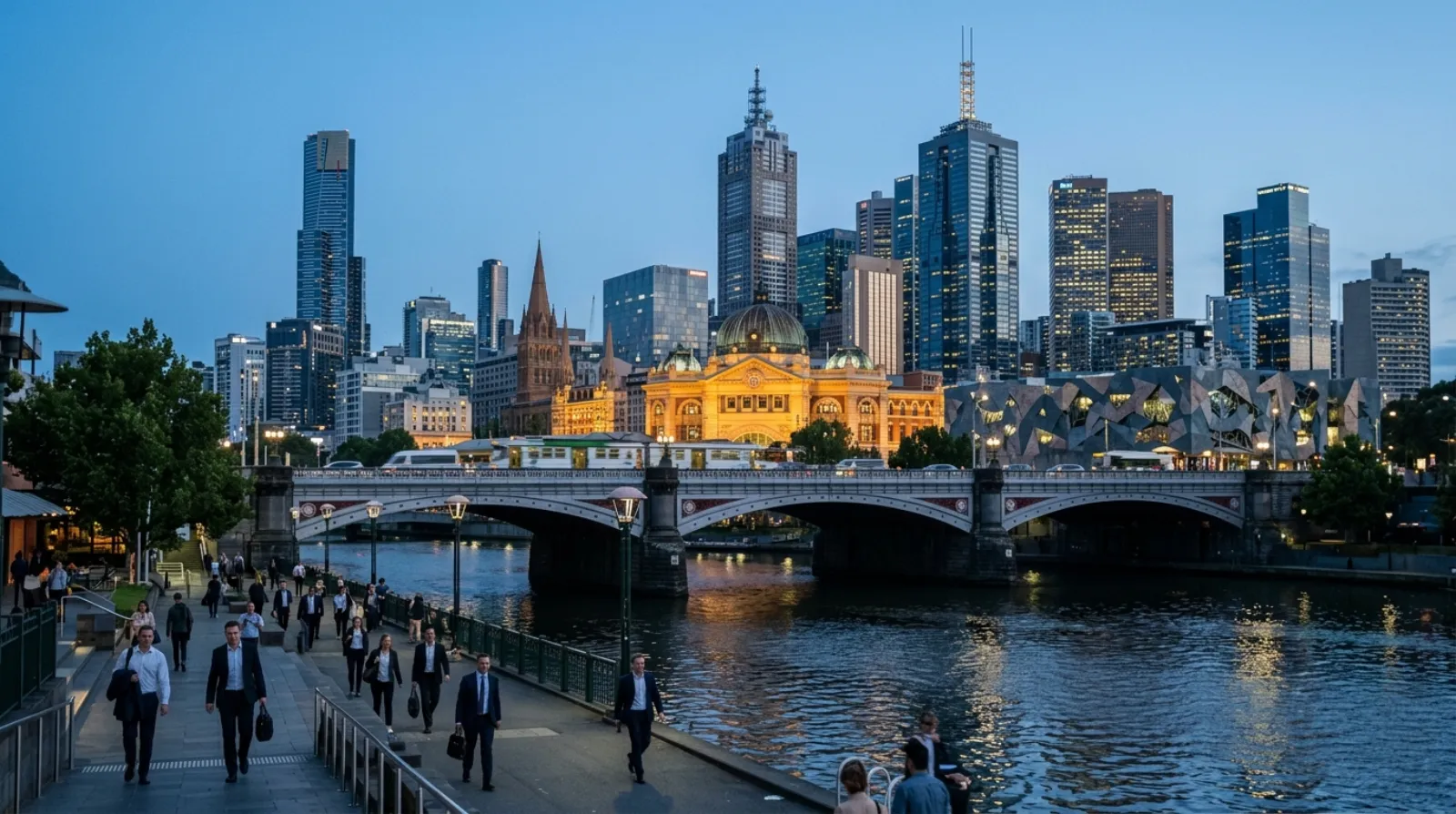
Australia & New Zealand · ATOL Protected
ATOL Protected
Business Class flights to Melbourne from the UK start from £3,477 return. No airline flies nonstop, so every trip connects once: Qatar Airways, Emirates, Etihad, Singapore Airlines and Cathay Pacific route through Doha, Dubai, Abu Dhabi, Singapore or Hong Kong, and the quickest takes about 21 hours. London is the cheapest UK departure and Newcastle costs £479 more.
Return fares per person from the UK. Your quote is confirmed against live availability for your dates.
Economy
From £872
return, per person
Premium Economy
From £1,853
return, per person
Business Class
From £3,477
return, per person
First Class
From £4,928
return, per person
Our fares. Prices shown for Melbourne are our own fares, based on recent bookings. Final business class fares depend on your dates, airline and availability. ATOL protected. Get a free exact quote or call 07862 620009.
London is the cheapest departure for Melbourne and has the deepest choice of hubs — all five carriers above are reachable. It is also where the fare advantage over the rest of the UK is widest in this cluster. If you live within a comfortable rail journey of a London airport, the decision is straightforward.
At £3,567, Manchester is £90 above London — the narrowest regional gap on this route, and small enough that for most travellers north of Birmingham it disappears entirely once you count the cost and time of getting to Heathrow. Manchester is well connected to the Gulf hubs, which is what makes the gap this narrow.
Birmingham at £3,678 sits £201 above London. That is the point at which the arithmetic genuinely turns, and it turns differently for different people: a family of two paying the gap twice is looking at £402, against a train fare and possibly a hotel. We work an example through below rather than guessing for you.
Glasgow at £3,835 and Newcastle at £3,956 carry the largest premiums on this route, £358 and £479 above London. Both have fewer hub options than Manchester, which is the underlying reason — fewer carriers competing on the first sector means less pressure on the fare.
This is genuinely different from the pattern on other Australian cities. Scottish and north-east travellers who have booked Perth or Adelaide before and found their local airport competitive should not assume the same holds for Melbourne. It does not.
London All LON → MEL
Business From £3,477
Manchester MAN → MEL
Business From £3,567
Birmingham BHX → MEL
Business From £3,678
Glasgow GLA → MEL
Business From £3,835
NewCastle NCL → MEL
Business From £3,956

London All (LON) ⇄ Melbourne (MEL)
LON → MEL

Manchester (MAN) ⇄ Melbourne (MEL)
MAN → MEL

Birmingham (BHX) ⇄ Melbourne (MEL)
BHX → MEL

Glasgow (GLA) ⇄ Melbourne (MEL)
GLA → MEL

NewCastle (NCL) ⇄ Melbourne (MEL)
NCL → MEL
Melbourne is the Australian city UK travellers most often book for a reason other than a holiday. Family, study, work, a wedding, a season of cricket or tennis — it draws a different kind of trip from Sydney, and the booking decisions that follow are different too. Business Class from the UK starts from £3,477 return.
Melbourne is also the one Australian city where your UK departure airport costs you the most money, and the one major gateway where there is still no train from the airport into town. Both of those are worth knowing before you book. What follows is the detail we would give you on the phone, and it sits alongside the rest of our Business Class flights to Australia and New Zealand.
Our current fares to Melbourne (MEL), by UK departure airport. Per passenger, return, subject to availability.
| UK departure | Business Class from | Difference vs London |
|---|---|---|
| London | £3,477 | — |
| Manchester | £3,567 | +£90 |
| Birmingham | £3,678 | +£201 |
| Glasgow | £3,835 | +£358 |
| Newcastle | £3,956 | +£479 |
Other cabins on the same route: Economy from £872, Premium Economy flights from the UK from £1,853, and First Class flights from the UK from £4,928.
That table is unusual, and if you are flying from outside the south-east it is the most important thing to understand before you book. On Melbourne the fare rises in a straight line the further north you start: London, then Manchester, then Birmingham, then Glasgow, then Newcastle, with no crossovers. Newcastle costs £479 more than London for the same cabin to the same airport.
Compare that with the rest of the region. On Business Class flights to Adelaide the cheapest departure is Glasgow, not London. On Business Class flights to Perth it is Glasgow again. On Melbourne, London wins outright and the gap widens steadily with every mile north.
The practical consequence: Melbourne is the one route in this cluster where positioning yourself to London is most likely to pay for itself, and we work that through properly further down rather than asserting it.
No. There is no nonstop service between any UK airport and Melbourne, and no airline has announced one. Every itinerary connects at least once.
One Australian city does have a UK nonstop — Perth, on Qantas from London Heathrow — and Qantas has announced nonstop Sydney–London flights from October 2027. Neither helps you reach Melbourne today. If a search result shows Melbourne as "direct" or "0 stops", that means one flight number, not no landing: a single-numbered service can still touch down en route. Always check whether the itinerary expands into two segments.
We checked what was genuinely on sale for a single common date — 15 November 2026, departing London Heathrow — so these are real itineraries rather than estimates. They are one day's availability, not a timetable.
| Itinerary type | Total time on that date | What it means |
|---|---|---|
| Quickest one-stop | 21h 10m | A tight, well-timed hub connection |
| Typical one-stop | 21h 25m – 24h 45m | The band most Business Class bookings fall into |
| Quickest two-stop | 25h 20m | Usually a regional UK feeder plus a hub |
| Slowest one-stop | 37h 00m | A long overnight wait at the hub |
Look at the first and last rows again. On the same day, to the same airport, both labelled one stop, the difference is nearly sixteen hours. The distance is identical. What changes is how long you sit at the hub.
This is the single most expensive mistake we see on Australian bookings, and it is almost always made by someone sorting a list by price. A fare that saves you £150 and costs you a fifteen-hour layover is not a saving, particularly when you are flying a cabin you have bought specifically so you can sleep flat and arrive able to function. Ask what the connection time is before you ask what the fare is.
Melbourne has the widest carrier choice of any destination in this region — five airlines we work with serve it, against three for Adelaide and none at all for Wellington. Each routes through its own hub.
| Airline | Connecting hub | Why you might choose it |
|---|---|---|
| Qatar Airways Business Class | Doha (DOH) | The strongest UK regional feed of the five; consistently well-regarded business seat, though the product varies by aircraft |
| Emirates Business Class | Dubai (DXB) | The broadest UK airport coverage, including airports the others do not reach |
| Etihad Business Class | Abu Dhabi (AUH) | Cleared for Melbourne but not for Perth or Adelaide, so it widens the shortlist here specifically |
| Singapore Airlines Business Class | Singapore (SIN) | Splits the journey closest to evenly, which suits travellers who dislike one very long sector |
| Cathay Pacific Business Class | Hong Kong (HKG) | A genuinely different routing across Asia rather than the Gulf |
We do not name a winner, because there is not one. The right answer depends on which UK airport you are starting from, how you feel about a very long first sector versus two more balanced ones, and which aircraft is actually scheduled on your dates.
Business Class is not one product. The same airline flies more than one business cabin, and which one you get depends on the aircraft assigned to your flight — which can change after you book. A carrier's newest suite and its older angled or less private seat can both be sold as business class on the same route in the same month.
So the useful question is not "which airline is best to Melbourne" but "which aircraft is operating my sector on my date, and what seat is in it". That is a question we answer when we quote, and it is worth more than any airline ranking.
The three Gulf carriers give you a long first sector of roughly seven hours and then a very long second one. Singapore and Hong Kong split the journey more evenly. Neither is better in the abstract; they suit different people.
If you sleep badly on planes and want the longest sector behind you while you are still fresh, the Gulf routings do that. If a single twelve-hour-plus leg is what you dread, the Asian hubs break the trip up. There is also a stopover to consider — you can break the journey properly in Business Class flights to Singapore, Business Class flights to Dubai, Business Class flights to Doha, Business Class flights to Abu Dhabi or Business Class flights to Hong Kong rather than treating the hub as dead time.
The fare is not the cost. Here is the same journey costed properly for four households, using the fares above. Rail and hotel figures are illustrative planning numbers, not quotes — your own will differ, and you should use your real ones.
| Traveller | Fly local | Fly London instead | What we would do |
|---|---|---|---|
| London or the South East | £3,477 | — | No decision to make. Fly from London. |
| Manchester and the North West | £3,567 | £3,477 + rail + the risk of a same-day connection | Fly Manchester. The £90 gap does not survive the train fare. |
| Birmingham and the Midlands | £3,678 | £3,477 + rail, roughly 90 minutes each way | Genuinely close. Worth pricing both, and it flips depending on party size. |
| Scotland | £3,835 | £3,477 + a flight or a long train, likely a pre-night hotel | Price both. £358 covers a positioning flight and a room, but it buys you a stressful extra day. |
| Business traveller, any origin | Local airport | London | Usually the local airport. A working day lost to positioning costs more than the fare gap. |
The honest summary for Melbourne: London is meaningfully cheaper, and unusually so — but "meaningfully cheaper" only converts into "actually cheaper" once you are far enough south, or travelling in a large enough party, for the gap to outrun the cost of getting there. For one person from Manchester it almost never does. For four people from Birmingham it often does.
Melbourne's seasons are inverted against the UK's. December, January and February are the Australian summer; June, July and August are its winter. December is the peak for UK traffic because it combines the Australian summer with the UK school holidays and with people travelling to family.
Melbourne's weather has a reputation for changing quickly within a single day, and that reputation is well earned; pack for more than one season regardless of the month. What the calendar means for your booking is simpler than what it means for your suitcase.
| Period | Australian season | What to expect when booking |
|---|---|---|
| December to February | Summer | Busiest for UK travellers. Book earliest, expect the least flexibility on dates |
| March to May | Autumn | Quieter after the January peak passes |
| June to August | Winter | Lowest UK demand of the year |
| September to November | Spring | Demand builds towards the December peak |
We describe these as demand patterns, not as fare promises. What a specific date costs depends on availability on that date, and we will tell you what it is rather than what it usually is.
Earlier than you would for Europe, and earlier than you think. Long-haul premium cabins have a limited number of seats, and on a route with no nonstop option the good itineraries — the ones with the twenty-one-hour connection rather than the thirty-seven-hour one — are the first to go.
For December and January travel, we would be having the conversation by the middle of the year. For the Australian winter, you have considerably more room. If your dates can move by a few days in either direction, say so when you enquire: it is the single most useful piece of flexibility you can give us.
| Cabin | From | Who it genuinely suits on this route |
|---|---|---|
| Economy | £872 | Travellers for whom the fare is the deciding factor, who can absorb arriving tired |
| Premium Economy | £1,853 | More space and a better seat, but it still reclines rather than lies flat |
| Business Class | £3,477 | A lie-flat bed on both long sectors, and lounge access through a long connection |
| First Class | £4,928 | Where it is offered on the aircraft operating your sector |
The distinction that matters on a twenty-one-hour journey is flat versus not flat. Premium Economy gives you width, pitch and a better service; it does not give you a bed. Travellers who land in Melbourne at breakfast time with a full day ahead usually conclude that the bed was the thing they were buying.
Melbourne Airport (MEL), at Tullamarine, has four terminals. All international arrivals come into Terminal 2. Terminal 1 is Qantas domestic, Terminal 3 is Virgin Australia domestic, and Terminal 4 handles Jetstar and other domestic services. The Emirates and Singapore Airlines lounges are both in T2.
If you are connecting onwards to another Australian city, you clear immigration and customs in T2 and then move to the relevant domestic terminal. Build proper time into that: you are collecting bags, clearing biosecurity and re-checking in, and Australian arrivals processing is thorough.
This surprises people, and it is worth knowing before you land rather than after. Melbourne is Australia's second-largest city and its airport has no rail link. SkyBus is the coach service into the city, and taxis and rideshare operate from the terminal forecourts.
Melbourne Airport Rail is being built. The Victorian Government's own project page states that Stage 1 — the West Footscray to Albion rail upgrade — is under way and will be complete in 2030. It does not publish a date for trains running to the airport itself, and we are not going to invent one. Plan on a road transfer for any trip you are booking now.
This is a genuine difference from the other eastern gateways: Sydney has a rail link from the terminals, and Business Class flights to Brisbane land at an airport with Airtrain running into the city in twenty minutes. Melbourne does not have an equivalent, and if you are choosing between arrival cities for a multi-stop trip, that belongs in the decision.
British citizens travelling to Australia as visitors need an Electronic Travel Authority before departure — it is not issued on arrival. Apply in good time rather than in the final week, and check the current requirements and any travel advice on GOV.UK Australia travel advice, which is the authoritative source and is updated as rules change.
Melbourne is nine to eleven hours ahead of the UK depending on the time of year, because both countries observe daylight saving and they do it in opposite seasons. In the UK winter the gap is at its widest. It is worth checking the actual difference for your travel dates rather than assuming, particularly if you have meetings or connections booked at the other end.
Because every Melbourne itinerary connects, you already have a stop. The only question is whether you spend it in a lounge or in a city. Each carrier handles this differently, and the differences are larger than the marketing suggests.
| Airline | Hub | What is actually offered |
|---|---|---|
| Etihad | Abu Dhabi | Etihad's own website offers a free hotel stay of up to two nights, in three- or four-star hotels, where you hold a return Etihad ticket and your stop is at least 24 hours and no more than four days. It must be booked direct with the airline. |
| Emirates | Dubai | Dubai Connect provides accommodation, meals and visas on qualifying long connections — but it applies to passengers whose shortest available connection happens to be long. You cannot choose a longer connection to obtain it. |
| Singapore Airlines | Singapore | The Singapore Stopover programme is a package you purchase, not a free stay. Singapore Airlines' own wording is that it "may be purchased" by passengers stopping over en route. |
| Qatar Airways | Doha | A Doha stopover programme is offered through Discover Qatar. Terms and pricing change, so check the airline's current page rather than a third-party summary. |
| Cathay Pacific | Hong Kong | No equivalent bundled stopover product. A Hong Kong stop is arranged as a normal extended layover. |
One correction worth making, because it costs people money: Dubai Connect is frequently described online as a "free Dubai stopover". It is not a stopover you can opt into. If a free hotel night at the hub genuinely matters to your plans, Etihad's Abu Dhabi offer is the one whose own terms use the word free — with the conditions above attached.
The phrase "business class" describes a fare, not a seat. On the routings to Melbourne you will encounter cabins that differ substantially: fully enclosed suites with a door, open lie-flat seats in a herringbone or staggered layout, and on some aircraft older seats that are less private and less comfortable. All are sold as business class.
Two things follow. First, if a particular seat matters to you — a door, direct aisle access, or two seats together that are genuinely side by side rather than staggered — you need to know the aircraft, not just the carrier. Second, aircraft are substituted. An airline can swap equipment weeks after you book, and the cabin changes with it.
We check the scheduled aircraft when we quote, and we will tell you where a route is known to vary. That is more useful than a ranking of airlines, because the ranking changes the moment the aircraft does.
Layouts differ enormously here. In a 1-2-1 staggered cabin the middle pair are sometimes close together and sometimes separated by a console, depending on the row. In a herringbone cabin you may be angled away from each other entirely. If you are travelling as a couple and want to be able to talk across the aisle, say so when you enquire — it is a seat-map question with a real answer, not a matter of luck.
The calculation is different when someone else is paying and the working week is the constraint. Two points matter more than the fare.
The first is the connection, again. A twenty-one-hour itinerary and a thirty-seven-hour itinerary cost roughly the same and consume entirely different amounts of your week. The second is the arrival time: landing in the morning with a full day ahead is not the same as landing at night, and on this route both are available. Tell us which meeting you have to make and we will work backwards from it.
Departing from a regional airport is also usually right for business travel even where London is nominally cheaper. The £90 Manchester premium or the £201 Birmingham premium is smaller than the value of not losing a working day to positioning, and far smaller than the cost of missing a connection because a train was late.
Business Class availability to Melbourne is sold in limited buckets, so moving a departure or return by a day or two can change which fares are open to you.
We hold fares from 5 UK departure points to Melbourne, and they are not the same. Tell us which airports you can realistically use and we will compare them together.
Two fares to Melbourne at a similar price can differ on connection time, total journey time, cabin on each sector, baggage and how the ticket can be changed.
A lower fare with a very long layover, an overnight wait or a change of terminal may not be better value than a slightly higher fare with a shorter, simpler connection.
If your plans could move, ask about change and cancellation conditions before you book. Flexibility is part of the price, and it is worth pricing deliberately.
We book this route regularly, and what we add is not a cheaper click — it is the part of the decision a comparison site does not make for you. Which of the five carriers suits your departure airport. Which aircraft is scheduled on your sector and what seat that actually means. Whether the connection is twenty-one hours or thirty-seven. Whether an open-jaw into Melbourne and out of Sydney saves you money and a domestic flight.
Tell us your dates, your UK airport and how much your dates can move, and we will come back with options and the reasoning behind them. If you are still comparing destinations, our Business Class flights from the UK hub covers the rest, and Business Class flights to Sydney is the obvious comparison for anyone deciding between Australia's two largest cities.
My Upcoming Trip is a UK travel agency specialising in premium cabins. We book Melbourne regularly, so you are talking to someone who knows the route rather than reading a listing. Our fares to Melbourne (MEL) are our own, priced from London, Manchester, Birmingham and other UK airports. What you pay depends on your dates, the airline and what is still available when we quote, so treat the figure above as a starting point. Before you pay we confirm the itinerary, the airline, the cabin actually fitted on your aircraft, the baggage allowance and the fare conditions in writing. If a neighbouring Australia & New Zealand route would suit you better, we will price that alongside it and tell you honestly which one we would book.
Send us your dates and we will price the itinerary by hand, confirm availability and set out the fare conditions in writing.
ATOL Protected
ATOL Protected No spam — details stay with our UK desk
Saved on this device only — pick up where you left off
Search a route or open a destination and it will be saved here so you can come back to it.