On this page (15)
- The mistake almost everyone makes
- What actually changes between cabins
- How to find out which aircraft you will be on
- The sub-fleet problem
- The aircraft you are most likely to meet
- Route and season change the answer
- Where to be sceptical of reviews
- Codeshares: who operates your flight?
- When the aircraft changes after you book
- Aircraft type versus everything else
- A worked example
- Short-haul and connecting sectors
- What we check before quoting
- The short version
- Verify before you book
Quick answer
Most major airlines fly three or four different business class cabins at once. The gap between the best and worst cabin within one airline is wider than the gap between two good airlines — and the seat map tells you which you are getting.
Quick answer: The aircraft operating your flight decides what business class you actually get, and most major airlines fly three or four different business class cabins at the same time. The gap between the best and worst cabin within a single airline is routinely wider than the gap between two well-regarded airlines. Before you book, find the aircraft type for your specific flight and date — not the route in general — because that single check tells you more than any airline review.
The mistake almost everyone makes
People book airlines. Airlines sell cabins. Those are not the same thing, and the gap between them is where most business class disappointment comes from.
A traveller reads that a particular airline has an outstanding business class, books it, and boards an aircraft fitted with a cabin that airline installed eleven years ago. Nothing has gone wrong. No one has misled them. They simply booked the brand and got the aircraft, and the aircraft is what they are sitting in for fourteen hours.
Large fleets are mixed by necessity. Retrofitting a widebody cabin takes an aircraft out of service for weeks and costs millions, so airlines do it gradually across a fleet of dozens of aircraft over several years. During that period — which is most of the time — the same airline flies the newest suite and a decade-old seat on the same route in the same week.
What actually changes between cabins
These are the differences that matter, in rough order of how much they affect a long flight.
Direct aisle access
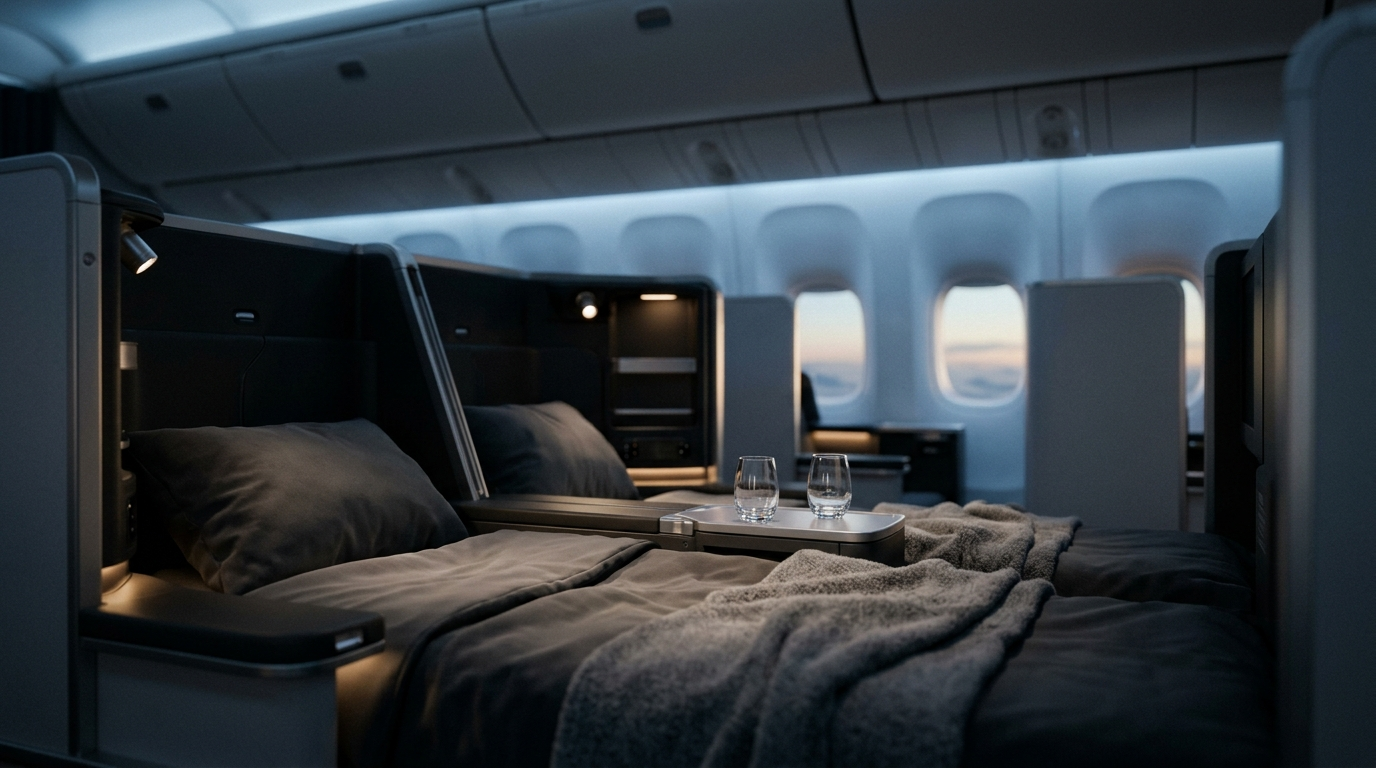
The most important single difference. A modern 1-2-1 layout gives every passenger their own path to the aisle. An older 2-2-2 layout does not: the window passenger has to climb past the aisle passenger, which on an overnight flight means either waking a stranger or lying still when you would rather not.
If you take one thing from this article, make it this. A 2-2-2 business class on a long-haul overnight flight is a materially worse product, and it is still out there on older aircraft.
Whether the seat actually lies flat
Fully flat is now standard on long-haul, but angled “lie-flat” seats — which recline to a slope rather than a horizontal bed — have not entirely disappeared from every fleet and every route. On a short-haul or medium-haul sector operated by a narrowbody, the business class seat may be an economy seat with the middle blocked. That is legitimate and normal; it is just not what most people picture.
Seat layout and head position
Reverse herringbone, staggered and herringbone cabins put your body in different relationships to the aisle. It affects privacy when seated and sleep quality when flat. We cover this in detail in our guide to the best business class seat for sleeping.
Doors and enclosure
Suite doors are a recent addition and are rolling out unevenly. Within one airline, some aircraft have them and some do not. Where they exist, they vary: some seal at the top, some leave a gap.
Cabin environment
This one is invisible on a booking page and genuinely affects how you feel on arrival. The Airbus A350 and Boeing 787 are pressurised to a lower cabin altitude with higher humidity than older aluminium aircraft, which most people notice across a long sector. The Airbus A380 is exceptionally quiet. An older 777 is a fine aircraft but does neither of those things as well.
Wi-Fi and power
Connectivity is fitted aircraft by aircraft, not airline by airline. If you need to work, this is worth checking specifically rather than assuming the airline's headline claim applies to your flight.
How to find out which aircraft you will be on
It takes about a minute.
- Search your actual dates. Aircraft assignments vary by day of week and by season. The route does not tell you; the flight on your date does.
- Read the aircraft type in the flight details. Booking engines display it, usually near the flight number — for example “Airbus A350-1000” or “Boeing 777-300ER”.
- Open the seat map. This is the real check. Count the seats across: 1-2-1 is the modern standard, 2-2-2 is the older arrangement to avoid on a long overnight sector.
- Check every sector, not just the long one. A twelve-hour flight in a suite followed by a three-hour connection in a narrowbody recliner is a normal itinerary. Know that before you fly, not at the gate.
Be aware of one trap: the aircraft shown at booking is a plan, not a promise. Airlines can and do change equipment, sometimes months ahead when schedules are rebuilt, sometimes on the day for operational reasons.
The sub-fleet problem
Knowing the aircraft type is often not enough on its own, and this is where casual advice falls down.
“Boeing 777” is not one cabin. A large airline may operate 777s in three different configurations: an original layout, a mid-life retrofit and a current-generation suite. All three display as a 777 in the booking flow. The seat map is what distinguishes them, which is why step three above matters more than step two.
The same applies to the A330, the 787 and the A350 across various carriers. The aircraft type narrows it down; the seat map confirms it.
The aircraft you are most likely to meet
You do not need to be an enthusiast, but a rough sense of the main long-haul types makes the seat map far easier to read.
Airbus A350
Currently among the best passenger environments in the sky: lower cabin altitude, higher humidity, quiet, and almost always fitted with a current-generation 1-2-1 business cabin because the aircraft is recent enough that few carry legacy seats. The A350-1000 in particular tends to carry an airline's flagship cabin. If your flight is on an A350, the odds are strongly in your favour.
Boeing 787 Dreamliner
Shares the A350's cabin-pressure and humidity advantages. Business cabins vary more widely than on the A350 because the 787 has been in service longer and different airlines specified very different seats. Worth checking the seat map rather than assuming.
Boeing 777
The workhorse of long-haul, and the type where checking matters most. The 777 fleet spans everything from original cabins through mid-life retrofits to brand-new door-equipped suites. Two flights on the same airline, on the same route, in the same week, can offer completely different products and both will say “777”.
Airbus A380
Exceptionally quiet and stable, with a sense of space no other aircraft matches. Business cabins are generally older in design terms because the type is no longer in production, and doors are rare. For sleep, the quietness partly compensates for a less enclosed seat.
Airbus A330 and Boeing 767
Smaller widebodies, often used on shorter long-haul routes and by leisure-focused carriers. Cabins vary enormously and older 2-2-2 configurations are more common here than on newer types. This is where the seat map check earns its keep.
Route and season change the answer
The aircraft on a route is not fixed. Airlines move equipment around to match demand, and that has consequences for what you get.
Peak leisure seasons frequently see larger aircraft on holiday routes and, on some carriers, older aircraft pressed into service to cover the extra flying. Business-heavy routes can see the newest cabins deployed on the timings business travellers prefer, with older equipment on the off-peak departures at the same price.
Day of week matters too. A route flown daily may use one aircraft type on weekdays and another at weekends. If your dates are flexible by a day, the seat map is worth checking either side of your preferred departure — occasionally the same fare buys a considerably better cabin twenty-four hours earlier.
Where to be sceptical of reviews
Business class reviews are useful, but they carry an expiry date that is rarely printed on them.
A review describes one flight, on one aircraft, on one day, often several years ago. If the airline has since retrofitted that fleet — or has not yet retrofitted the aircraft you are booked on — the review describes a product you will not experience. Photographs are the giveaway: if the seat in the photograph does not match the seat map for your flight, the review is not about your flight.
The same caution applies to awards. An airline award is given to a carrier, not to the aircraft you are booked on. It tells you something real about the airline's ambitions and standards; it does not tell you whether your particular flight has direct aisle access.
Use reviews for service culture, catering style and general reliability. Use the seat map for the seat.
Codeshares: who operates your flight?
A ticket sold by one airline may be operated by another. You can book what looks like a flight on a premium carrier and travel in a partner's cabin, which may be very different from the one you had in mind.
The booking will say “operated by” somewhere, and it is worth finding. The cabin, the catering, the baggage rules and the lounge you can use are generally determined by the operating carrier, not the one whose code is on the ticket. Our guide to mixing airlines on a business class trip covers how these tickets work in practice.
When the aircraft changes after you book
Equipment swaps are routine. Most are minor; some change your product materially.
The practical consequences are that your seat is usually reassigned automatically — and the automatic choice is rarely the seat you would pick — and that the cabin itself may differ. A swap from an A350 to an older 777 can move you from a suite with a door to a seat without one.
What you can do: watch for schedule-change emails, re-open the seat map whenever you get one, and choose again. If the change is significant and close to departure, it is worth asking the airline what options exist. Policies vary and are not always volunteered. We cover the detail in our guide on what happens when your business class flight changes aircraft.
Aircraft type versus everything else
Aircraft matters. It is not the only thing that matters, and it is worth being clear about where it sits.
Routing usually beats aircraft. A better cabin that requires a domestic connection to Heathrow, an extra bag handover and four more hours of travelling is often the worse trip. Departing from your own airport is worth a lot.
Schedule usually beats aircraft. An overnight departure with eight hours of dark cabin beats a superior seat on a daytime flight if you need to sleep.
Fare brand can beat aircraft. The finest suite in the sky on a fare that removes lounge access, seat selection and any flexibility may not be the better purchase.
Aircraft beats airline reputation. This is the one people get backwards. A current-generation cabin on a mid-tier airline will usually give you a better night than a decade-old cabin on a famous one.
A worked example
Two itineraries to Southeast Asia, priced within about eighty pounds of each other.
This scenario plays out constantly on the long Asia and Australia routes — compare current fares to Bangkok, Singapore and Sydney and you will see several carriers on each, flying very different cabins.
Option A: a well-known airline, evening departure, operated by an older widebody in a 2-2-2 configuration. Excellent service, good food, and a window seat you cannot leave without disturbing your neighbour.
Option B: a less-discussed airline, similar departure time, operated by a current-generation A350 in a 1-2-1 staggered cabin with direct aisle access and a lower cabin altitude.
On brand reputation, most travellers pick A. On the actual overnight experience, B is clearly better, and the eighty pounds is not the deciding factor in either direction. This scenario is not unusual — it is close to routine on several long-haul markets, and it is exactly what checking the seat map reveals in under a minute.
Short-haul and connecting sectors
One more thing worth knowing before you book, because it surprises people.
Business class on a short intra-European or intra-Asian sector is often a standard economy seat with the adjacent seat blocked, better catering and lounge access. That is the normal industry arrangement and not a downgrade in any misleading sense — but if your itinerary is a long-haul suite plus a two-hour connecting flight, do not expect the second sector to resemble the first.
The same applies in reverse. If a connecting sector is operated by a regional partner on a smaller aircraft, the cabin, baggage handling and lounge access can all differ from the main carrier's.
What we check before quoting
- The aircraft type on every sector, on the client's actual dates
- The seat map, to confirm the sub-fleet and the layout — 1-2-1 or 2-2-2
- Whether each sector is operated by the marketing carrier or a partner
- Whether the long-haul cabin is a suite, a reverse-herringbone seat, a staggered seat or an older configuration
- What the short connecting sectors are actually flown by
- The fare brand, and what it includes at that price
- What the airline's policy is if the equipment changes after ticketing
We do not guarantee a specific aircraft, because no agent honestly can — airlines change equipment and we do not control their operations. What we do is tell you what is currently scheduled, what cabin that means, and what to re-check if it moves.
The short version
Do not ask which airline has the best business class. Ask which aircraft is operating your flight, on your date, and what the seat map looks like. That question takes a minute and will improve your flight more reliably than any amount of brand research.
Verify before you book
Fleet configurations and retrofit programmes change continuously. Confirm the aircraft and cabin for your specific flight on the operating airline's own site before booking, and re-check after any schedule-change notification. For UK passenger rights in the event of a cancellation or long delay, the Civil Aviation Authority is the correct reference.
Routes in this guide
Related Business Class routes
Current private UK fares for the destinations covered above. Quotes are dated to your itinerary — this is not a live checkout.
Keep reading
Related reading
References
Sources
Rules and fares change. These are the references behind the factual claims above — check them yourself before you travel.
Why the Aircraft Type Matters More Than the Airline Name in Business Class — FAQs
Prefer to talk? 786 262 0009 .
Why is business class different on the same airline?
Because retrofitting a widebody cabin takes an aircraft out of service for weeks and costs millions, airlines upgrade fleets gradually over several years. During that period the same airline flies its newest suite and a decade-old seat on the same route in the same week.
How do I check which aircraft my flight uses?
Search your actual travel dates, read the aircraft type in the flight details, then open the seat map. The seat map is the definitive check because one aircraft type can carry several different cabins across an airline's sub-fleets.
What is the difference between 1-2-1 and 2-2-2 business class?
In a 1-2-1 layout every passenger has direct aisle access. In an older 2-2-2 layout the window passenger must climb past the aisle passenger, which on an overnight flight means waking a stranger or staying put. On a long overnight sector, 2-2-2 is a materially worse product.
Is knowing the aircraft type enough?
Not always. A large airline may fly Boeing 777s in three different configurations, and all three appear simply as a 777 in the booking flow. The aircraft type narrows it down; the seat map confirms which cabin you are actually getting.
Does the aircraft affect how I feel when I land?
Yes. The Airbus A350 and Boeing 787 are pressurised to a lower cabin altitude with higher humidity than older aircraft, and the Airbus A380 is exceptionally quiet. Most travellers notice the difference across a long sector, though none of it appears next to the price.
What happens if my aircraft changes after booking?
Your seat is usually reassigned automatically, and the cabin itself may differ - a swap from an A350 to an older 777 can move you from a suite with a door to a seat without one. Re-open the seat map after any schedule-change notification and choose again.
What does operated by another airline mean for my cabin?
The cabin, catering, baggage rules and lounge access are generally set by the operating carrier rather than the airline whose code is on the ticket. Find the operated by line in your booking, because it may be a very different product from the one you expected.
Is business class on a short connecting flight the same?
Usually not. On short intra-European or intra-Asian sectors, business class is often a standard economy seat with the adjacent seat blocked, plus better catering and lounge access. That is normal, but do not expect it to resemble the long-haul suite on the same ticket.
Does aircraft type matter more than the airline?
For the cabin you sit in, yes. A current-generation cabin on a mid-tier airline will usually give you a better night than a decade-old cabin on a famous one. Routing, schedule and fare brand can still outrank the aircraft depending on your trip.
Can an agent guarantee a specific aircraft?
No, and you should be cautious of anyone who says otherwise. Airlines change equipment for operational reasons. What a good agent can do is tell you what is currently scheduled, what cabin that means, and what to re-check if it moves.