On this page (12)
- Who gets a seat, and who does not
- Bassinets: why the seat advice reverses
- Choosing seats for a family
- Is business class worth it with children?
- Lounges with children
- The flight itself
- Jet lag, children and the return leg
- What we would say honestly
- Documents and permissions
- Pushchairs, car seats and equipment
- What we check for a family booking
- Verify before you book
Quick answer
The seat advice reverses when you travel with an infant — you want the bulkhead row everyone else avoids, because that is where bassinets attach. And a lap infant gets no bed at all.
Quick answer: Business class with children works well on long overnight flights, and the seat advice is the opposite of the advice for adults travelling alone. If you need a bassinet you want the bulkhead row — the row experienced travellers avoid for noise — because that is where bassinets attach. Infants under two normally travel on a lap for a percentage of the adult fare without their own seat or flat bed, which is the detail that most often changes the plan.
Who gets a seat, and who does not
Start here, because it determines everything else.
An infant under two normally travels on an adult's lap. The fare is typically a percentage of the adult fare plus taxes, and crucially the infant does not get their own seat — which means no flat bed of their own on a business class ticket. Some airlines allow you to buy a seat for an infant, which requires an approved car seat or restraint.
A child of two or over requires their own seat and pays a child fare, which in business class is often close to the adult price. This is where the arithmetic gets serious: a family of four in business class on a long-haul route is a substantial purchase, and the child does get a full flat bed for it.
The age is assessed at the date of travel, not the date of booking. A child who turns two during a trip may need a seat for the return leg even though they travelled on a lap outbound. Airlines apply this strictly and it catches families out.
Bassinets: why the seat advice reverses
For an adult travelling alone, we consistently advise avoiding the bulkhead row: it sits behind the galley, and on an overnight flight the noise, light and crew movement make it the worst row in the cabin for sleeping.
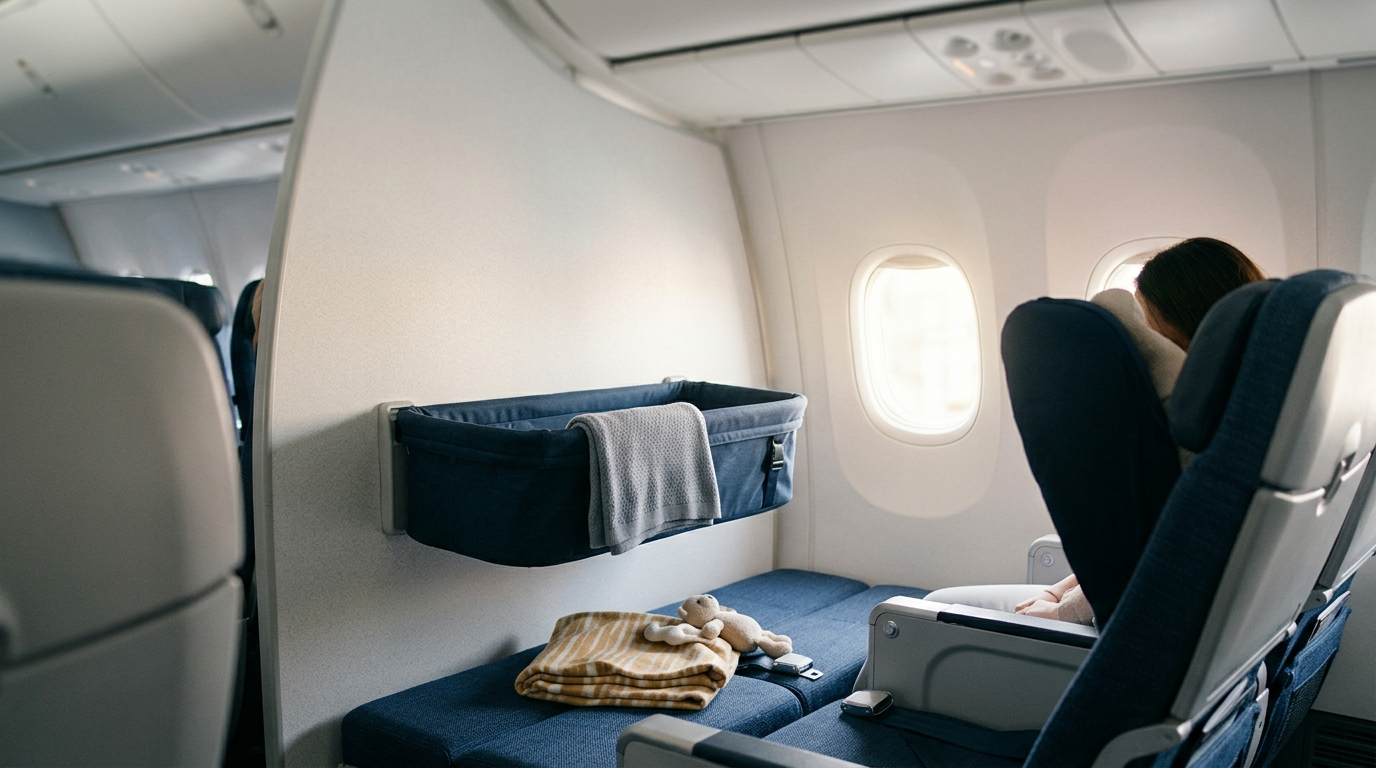
With an infant, that advice inverts. Bassinets attach to the bulkhead wall, so the bulkhead is where you need to be. There is no alternative position.
Practical points. Bassinet positions are limited — often only a small number per cabin — and cannot usually be guaranteed at booking; they are requested and confirmed later, sometimes at the airport. Request early, reconfirm before departure, and understand that weight and length limits apply, so a large one-year-old may not fit even though they are under two.
Not every business class cabin can accommodate a bassinet at all. In some suite layouts the geometry does not allow it. If a bassinet is essential, check before booking rather than after.
Choosing seats for a family
The layout that suits adults travelling alone is often the worst one for families, and this is worth understanding before you choose a flight.
Modern 1-2-1 cabins give every passenger direct aisle access and high privacy dividers. Excellent for a solo traveller; awkward for a parent who needs to see and reach a child, because each seat is a separate enclosed pod. In some suite layouts you genuinely cannot see the next seat while seated.
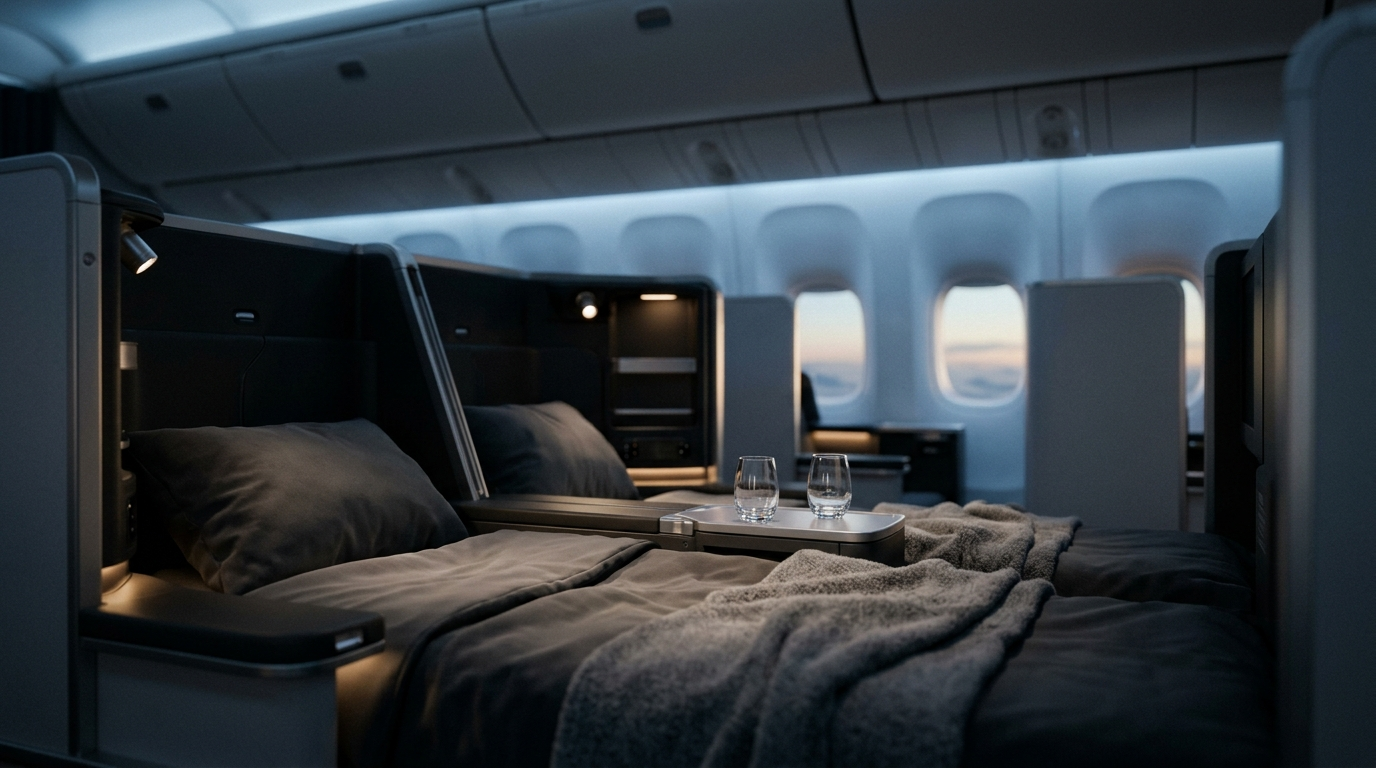
The centre pair is the answer in most cases. In a 1-2-1 cabin the two middle seats sit together with a divider that lowers, and on some aircraft they convert into a double bed — which for a parent and a young child is far more practical than two separate pods.
If you are travelling with two children, look for cabins where four seats can be arranged together, or consider a staggered layout, which tends to place seats in more sociable relationships than a strict reverse-herringbone cabin.
Our guide to business class seat layouts explains the differences; simply read the recommendations in reverse when travelling with children.
Is business class worth it with children?
An honest assessment, because the answer is not always yes.
It is worth it when: the flight is overnight and long; the children are old enough to sleep in a flat bed, which usually means around three and up; you are arriving somewhere that requires you to function on arrival; or the trip is long enough that arriving wrecked would cost you a day or two of the holiday.
It is less compelling when: you have a lap infant who gets no bed regardless of cabin; the flight is daytime, when children rarely sleep anyway and the flat bed goes unused; or the price difference would fund a materially better holiday at the other end.
In practice the family routes we quote most are Business Class flights to Orlando and Dubai — one a long daytime westbound, the other a shorter overnight, and the calculation is different on each.
The strongest case for a family is genuinely the overnight long-haul flight where everyone arrives having slept. The weakest is a daytime flight where you are paying a large premium for beds nobody uses.
Lounges with children
Business class lounges vary enormously in how well they suit families, and the best-rated lounge is frequently not the best one for you.
The Emirates lounge in Dubai has a children's playroom and enormous space, which on a long connection is worth more to a family than a quieter, more elegant room. Changi's wider terminal facilities are excellent because you are not confined to the lounge. At Heathrow, Virgin's Clubhouse is a superb lounge but is designed as an adult space, and a family may be more comfortable somewhere with more room to move.
Two practical notes. Lounge access depends on your fare brand rather than your cabin, so check it is included. And an infant travelling on a lap is normally admitted with the accompanying adult, but confirm rather than assume, particularly where a lounge is operating at capacity.
The flight itself
Boarding
Families are often invited to board early, and business class boards early anyway. Consider whether you want to: early boarding means more time sitting on a stationary aircraft with a child who is already restless. Sometimes boarding last is the better call, with one adult taking the bags on early and the other bringing the children at the end.
Meals
Children's meals must usually be requested in advance, typically at least 24 hours before departure. Business class catering is served on demand rather than to a fixed schedule, which is a genuine advantage — you can feed a child when they are hungry rather than when the trolley arrives.
The same advice that applies to adults applies here: if the plan is sleep, eat before boarding or early in the flight, then get the cabin dark.
Sleep
A flat bed helps enormously, but the cabin is unfamiliar and the routine is broken. Bringing something from home — a blanket, a toy, the usual bedtime book — does more for a child's sleep than the specification of the seat.
Ears on descent
The most common source of distress, and largely manageable. Feeding an infant during descent, or giving an older child something to drink or chew, helps equalise pressure. Cabin crew are experienced with this and will usually help if asked.
Jet lag, children and the return leg
Children generally adjust to a new time zone faster than adults, which is the good news. The harder part is the days immediately after arrival, and the flight itself contributes less than parents expect.
What helps most is the arrival time rather than the cabin. Landing in the morning and keeping everyone awake, outdoors and in daylight until a normal local bedtime is the most effective reset, and it is a schedule decision made at booking rather than something the seat can fix.
The return leg deserves as much thought as the outbound. Families routinely spend the money on the flight out and take whatever is cheapest coming home, then arrive back needing to function immediately — school, work, routine. If the budget only covers one direction in business class, think carefully about which one your household will actually find harder.
What we would say honestly
Families are sold business class enthusiastically, and it is not always the right purchase. A few plain observations.
With a lap infant on a daytime flight, you are paying a large premium for a bed your child cannot use and a cabin that is quieter than your party will be. Premium economy plus a better hotel is frequently the better trip.
With children aged roughly three to ten on an overnight long-haul flight, business class is genuinely transformative — everyone sleeps, everyone arrives usable, and the first two days of the holiday are not written off.
With teenagers, it is a straightforward comfort purchase like any other, and the usual considerations apply.
Documents and permissions
Children need their own passports, and many destinations require validity beyond the travel dates. Some countries ask for additional documentation where a child travels with only one parent or with a guardian — a letter of consent, or evidence of parental responsibility.
Rules vary by destination and change, so check the GOV.UK foreign travel advice for your destination well before departure. This is not something to discover at the airport, and no airline or agent can override an entry requirement.
Pushchairs, car seats and equipment
Pushchairs and car seats are normally carried free of charge in addition to your baggage allowance. Whether you can take a pushchair to the aircraft door and collect it there varies by airline and airport — and at some airports it is returned to the baggage hall instead, which matters if you have a long connection.
Ask about gate delivery specifically. Arriving at a large hub with a tired toddler and no pushchair for a twenty-minute walk to the next gate is a bad way to find out.
What we check for a family booking
- Ages at the date of travel, including whether a child turns two mid-trip
- Whether the aircraft can take a bassinet, and whether positions are available
- Cabin layout, and whether seats can genuinely be together
- Whether the fare brand includes lounge access and seat selection
- Lounge facilities at the connecting hub, not just its rating
- Connection length, and whether it is realistic with children
- Pushchair handling and whether gate delivery is available
- Whether the overnight sector is the one worth paying for
We will tell you when business class is not the right purchase for a family trip. On a daytime flight with a lap infant, the honest answer is often that premium economy plus a better hotel is the better use of the money.
Verify before you book
Infant and child fare rules, bassinet availability and equipment policies vary by airline and change. Confirm with the operating airline before booking, and check entry and documentation requirements for children on the GOV.UK foreign travel advice pages for your destination. For UK passenger rights, the Civil Aviation Authority is the correct reference.
Routes in this guide
Related Business Class routes
Current private UK fares for the destinations covered above. Quotes are dated to your itinerary — this is not a live checkout.
Keep reading
Related reading
References
Sources
Rules and fares change. These are the references behind the factual claims above — check them yourself before you travel.
Business Class with Children: What UK Families Should Know Before Booking — FAQs
Prefer to talk? 786 262 0009 .
Do infants get their own seat in business class?
Normally no. An infant under two travels on an adult's lap for a percentage of the adult fare plus taxes, and does not get their own seat or flat bed. Some airlines allow you to buy a seat for an infant, which requires an approved car seat or restraint.
Which seat do I need for a bassinet?
The bulkhead row, because bassinets attach to the bulkhead wall and there is no alternative position. This reverses the usual advice, since the bulkhead sits behind the galley and is the row solo travellers avoid for noise.
Can I guarantee a bassinet position when I book?
Usually not. Positions are limited, often only a few per cabin, and are requested then confirmed later, sometimes at the airport. Request early, reconfirm before departure, and check the weight and length limits, as a large one-year-old may not fit.
How much does a child pay in business class?
A child of two or over needs their own seat and pays a child fare, which in business class is often close to the adult price. The age is assessed at the date of travel, so a child who turns two mid-trip may need a seat for the return leg.
Which business class layout is best for families?
The centre pair in a 1-2-1 cabin, where two seats sit together with a divider that lowers and on some aircraft convert into a double bed. Individual suite pods give excellent privacy but can prevent a parent from seeing or reaching a child.
Is business class worth it with children?
It is strongest on long overnight flights where everyone arrives having slept, and where children are old enough to use a flat bed. It is least compelling with a lap infant who gets no bed regardless, or on daytime flights where the beds go unused.
Which lounges are best with children?
The Emirates lounge in Dubai has a children's playroom and a lot of space, and Changi's wider terminal facilities work well because you are not confined to the lounge. Virgin's Clubhouse at Heathrow is superb but designed as an adult space.
Should we board early with children?
Not always. Early boarding means longer sitting on a stationary aircraft with a restless child. A common approach is one adult boarding early with the bags and the other bringing the children at the end of boarding.
Can I take a pushchair to the aircraft door?
Often, but it varies by airline and airport, and at some airports it goes to the baggage hall instead. Ask about gate delivery specifically, because arriving at a large hub with a tired toddler and no pushchair for a long walk is worth avoiding.
What documents do children need?
Their own passports, often with validity beyond the travel dates. Some destinations require extra documentation where a child travels with one parent or a guardian, such as a letter of consent. Check GOV.UK foreign travel advice for your destination well before departure.